

EM: You have spent more than a decade running one of the most established names in cultural analytics. Why was now the moment to write a book, and why this book?
Schram: The world has become more disconnected than ever. Social media has increased an overall sense of people no longer really knowing where they belong. Being an immigrant to Finland, which got a very nationalistic government made me realize that when we treat people like “foreigners” we segregate, we push people away. Yet, when we realize that we are all foreigners in one way (e.g. nationality) or another (function, village, region, sports team, education, generation, etc) – we can actually take a breath and treat being different not as scary, but as a great source of different perspectives and focus on what really matters – build connection.
EM: You trained as a forester at Wageningen, specialised in environmental psychology, and ended up running a global culture-consulting business out of Helsinki. Walk us through the line. What does forestry have to do with organisational culture?
Schram: Everything. It takes 80 years to grow high quality wood. During those years you need to earn money. So the long-term / short-term question is prevalent in any organisation. Additionally, in the Netherlands we have very little forest, with a lot of people, so balancing everybody’s interest/stake is important to maintain harmony. It is the same for any business, clients/owners/shareholders/providers/employees, everybody wants something. Everybody experiences something, so the question is how to balance all of this. That’s a systems question.
EM: Your book "Navigating Foreignerness" opens from the perspective of someone who has lived as a foreigner. You are Dutch, you chose Finland. What is the one thing about being a foreigner in your own life that you did not understand until you sat down to write it?
Schram: That how we use time, in this specific case to reflect, is crucial. You can live your life in ignorance, in a bubble. To take time is to observe, to reflect. To understand.
EM: Was there a moment, a specific moment, when you knew Finland had become home rather than a country you were working in?
Schram: Finland is not really my home. Helsinki, as a city, has become my home. Every single time I come back from a trip abroad I can notice the tranquillity, the space to live and not be lived.
REFRAMING "FOREIGNERNESS"
EM: You chose the word foreignerness over more familiar alternatives like expat, outsider, immigrant. What does that word do that the others do not?
Schram: It is a word play on the word “Foreigner”, to indicate a sense of being different, to be “other”, but also that it’s part of you that is, not all of you. Your behaviour might seem different, it does not need to mean you are different. The other words carry more of a judgemental tone to them, for me they are built on a complete sense of difference. Almost like you’ll never belong.
EM: Early readers describe the book as reframing foreignerness 'not as a barrier'. If it is not a barrier, what is it?
Schram: It’s a reflection on where you are different, and where you’re similar. So it can give you a sense of agency to build bridges across those differences.
EM: The book pairs personal stories with the Culture Compass, your firm's analytical tool. Why fuse the two? What is the danger of stories without data, or data without stories?
Schram: For me, fusing the two is about balance. The Culture Compass provides the breadth, the macro-level data, validation, and structural trends that show us the bigger picture. The personal stories provide the human depth, the lived experiences that make those numbers real. The danger of stories without data is that you risk relying on anecdotes. You might have a compelling narrative, but without data, you don't know if it’s a widespread reality or just an isolated incident. The danger of data without stories is that it becomes sterile. Numbers can tell you what is happening, but without stories, you lose the why, the empathy, and the human impact driving those metrics. Fusing them ensures the insights are both structurally sound and deeply human.
EM: Which single story from the book do you most hope an executive reading it on a plane will not be able to put down?
Schram: Dino’s story because it provides a powerful lense of what happens when your country disappears and the identity crises which can come from there and how work can provide a meaningful balance.

THE PRACTITIONER'S LENSE
EM: You have grown The Culture Factor Group across more than sixty countries, sixty-plus nationalities, a gender-balanced team, and an age range from twenty-two to seventy-five. What did running that organisation actually teach you that you could not have learned consulting from the outside?
Schram: That how you manage time indicates what you deeply care about. And that building rituals can carry a very strong sense of belonging. It also thaught me about the deep emotions linked to sense of ownership and how difficult change can be for many.
EM: Without naming the client, tell us about a moment where a Fortune 100 leadership team got culture catastrophically wrong, and what the corrective looked like.
Schram: This was an oil and gas company trying to install a new drill platform. Due to cross cultural clashes between the captain of the boat and the crane captain (each representing a different company), they were facing a 6-month delay. After our intervention the platform was installed within one month. We had a consultant onboard for 3 days to do participatory observation, assessed the organisational cultures of both teams on board, helped the individuals to visualize their own cultural value preferences and brought all of that together into a one-day workshop aimed a building joint ways of working.
EM: The book argues that true culture change begins at the individual level. A lot of culture work is sold as top-down: the CEO sets the tone, cascade it down. Are you arguing the opposite?
Schram: No. I’m arguing the “and” angle. You need the CEO to own Culture as Cultural Executive Owner(ship). But that’s not enough. Individuals also need to understand their own sense of agency and how that relates to the people they work with. A CEO needs to set the purpose, the direction. The individuals need to live it.
EM: Why is this book for leaders and not, say, for the HR director who actually runs culture inside most organisations?
Schram: Because HR in most cases does not understand it needs to manage the collective, and not the individual. 11 gifted players do not make for a high performing team without understanding that they need to leverage their brilliance for the team. HR’s biggest blind-spot is its own cultural programming. Managing this collective starts at the executive level, where HR needs to hold the executive team accountable for acting like a team.
EMOTIONAL SUTAINABILITY & THE CEO
EM: You have used the phrase 'Cultural Executive Ownership', playing on the CEO acronym. In practice, what does it look like when a chief executive truly owns the culture of their company, versus delegating it?
Schram: Well, you can quickly notice that they hold themselves accountable to behave in a way which reflects the optimal culture of the organisation and hold their executive team accountable as well to the same standard.
EM: Emotional sustainability is one of the book's anchor concepts. How do you know, as a practitioner, on a Tuesday morning, whether a culture is emotionally sustainable or quietly burning out?
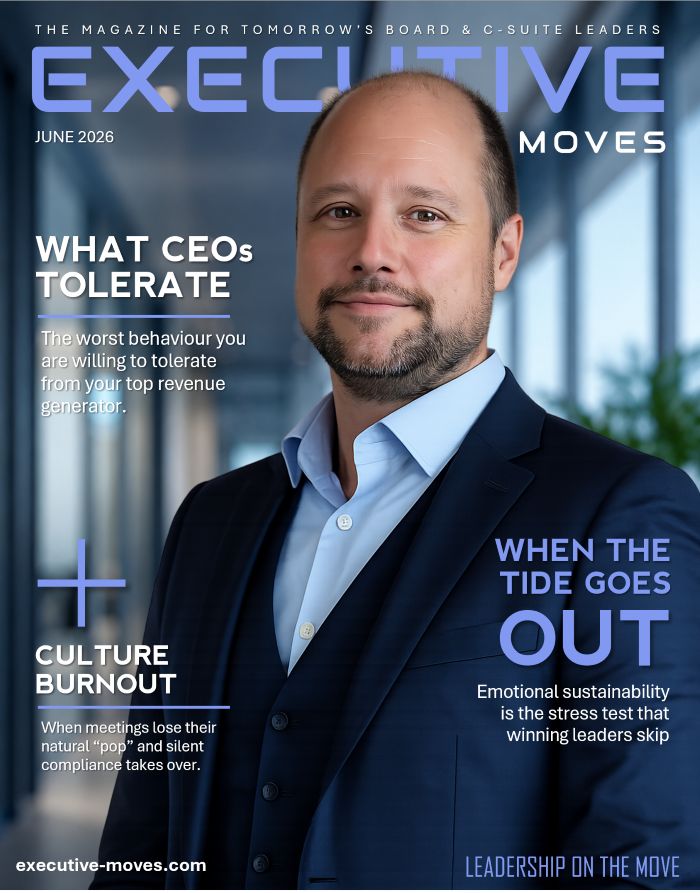
Schram: In a sustainable culture, morning meetings have a natural "pop", people debate ideas, push back, or offer spontaneous thoughts. In a culture burning out, meetings are marked by compliant silence. People just want to get through the agenda; they nod, log off, and crawl back to their silos because they don't have the emotional energy to engage. So watch how people communicate laterally. Are Slack channels or hallway chats filled with collaborative problem-solving and dry humor, or is there an undercurrent of cynical venting? Cynicism is the primary psychological defense mechanism against burnout. One early warning signal when a culture is quietly burning out, is that productivity doesn't drop right away, it actually spikes or holds steady because your most dedicated people will sacrifice their well-being to keep the ship afloat. They use friction, over-working, and hyper-vigilance to maintain the standard.
EM: You have written that engagement scores are useful, but that happy employees alone do not prevent bankruptcy. What should boards be measuring instead, or in addition?
Schram: An engagement score tells you if people like working there today; it doesn’t tell you if the organization can survive a crisis tomorrow. To protect against strategic blind spots, boards in my opinion should look beyond engagement and measure three specific operational health indicators. First, Psychological Safety vs. Compliant Silence: Don't just track 'satisfaction.' Measure how often bad news or divergent ideas are escalated from the front lines to executives. A culture where no one challenges the status quo is a structural risk. Second, Time-to-Execution: Are we losing our agility? Measure the velocity of decision-making. If it takes six layers of approval to fix a customer problem, employees might be 'happy' because they are comfortable, but the business is stagnating. Third, Cognitive Friction and Cognitive Load: Track the gap between our strategic ambitions and the actual capacity of our teams. Are we expecting hyper-performance with legacy tools and broken processes? Engaged employees are great, but aligned, agile, and psychologically safe employees are what prevent bankruptcy (besides ensuring you have an ok cash flow)
EM: Back in 2016 you published a piece titled 'Why culture does not matter (that much) when you're doing well'. The new book argues that emotional sustainability is exactly what fuels long-term success. Did the view shift, or were you saying the same thing in two different keys?
Schram: It’s the exact same song, just played in a different key because the economic climate changed. Back in 2016, during a period of relative market stability and growth, my point was that high performance and strong financial winds can mask a toxic or fragile culture. When the tide is high, everyone looks like a genius, and cracks in the cultural foundation don’t show up on the balance sheet right away. Culture looks optional when you're winning by default.
The new book focuses on what happens when the tide goes out. Emotional sustainability is the ultimate stress test for long-term success. It isn't about being 'nice' during the good times; it’s about ensuring your people have the emotional reserves, trust, and psychological safety to innovate, pivot, and endure when the market gets brutal.
In 2016, I was warning leaders not to let short-term financial success blind them to cultural rot. Today, I am giving them the playbook for building an organizational engine that won't burn out when the pressure is turned up to maximum.
Part five: The provocations
EM: Where does conventional culture consulting most often get it wrong?
Schram: Conventional culture consulting treats culture like a therapy session instead of an operational system. They focus heavily on 'mindsets,' workshops, and encouraging people to be nicer to each other. It gets it wrong because it decouples culture from strategy. You cannot fix a cultural bottleneck without fixing the operational friction, the incentives, and the power structures that created it.
Because our heritage is deeply rooted in data, analytics, and structural frameworks, our temptation is to occasionally treat human systems too much like engineering problems. We can get so caught up in optimizing the data matrices that we risk underestimating the messy, emotional, irrational side of human friction. We sometimes assume that showing leaders a logical data model will automatically change their behavior, forgetting that ego and corporate politics often come in the way.
EM: There is real fatigue around DEI as a banner. What is the conversation about culture and difference that should be happening instead?
Schram: The conversation needs to shift from a moral obligation to an operational capability. The fatigue exists because DEI became an HR compliance exercise centered around policing language and optics, which naturally creates defensiveness. The conversation we should be having is about Cognitive Diversity and Friction Management. When you bring different cultural backgrounds together, you aren't just bringing 'representation', you are (potentially) bringing fundamentally different ways of problem-solving, risk calculation, and communication. If a team has high national and cognitive diversity but low psychological safety, the result is crippling operational friction. We need to stop talking about 'inclusion' as a passive kumbaya concept and start talking about building the specific behavioral infrastructure required to convert diverse perspectives into actual commercial speed.
EM: When does culture work become HR theatre (colourful posters, town halls, values on a wall), and how does a leader spot it in their own organisation?
Schram: Culture work becomes HR theatre the exact moment the stated values require a 'sacrifice' that leadership isn't willing to make. If your corporate value is 'Innovation,' but your budget lines only reward safe, predictable short-term margins, you are performing theatre. A leader can spot this instantly by looking at the delta between what is celebrated in town halls and what actually gets people promoted. If your town halls praise collaboration, but the person who just got promoted to VP is a notorious, toxic individual contributor who hit their revenue targets by burning out their team, your culture is a fiction. When the unofficial 'shadow rules' of survival and advancement in your company contradict the colorful posters on the wall, you aren't building a culture—you are running a (bad) marketing campaign.
EM: You inherit Geert Hofstede's legacy and you are also pushing beyond it: Consumer Cultural Intelligence, AI agents, the Culture Compass. What is the part of the original Hofstede framework that no longer holds up the way it used to?
Schram: The part that no longer holds up is the rigid assumption that national borders act as clean containers for culture. Geert’s pioneering work was built in an era of sovereign corporate hubs, an IBM employee in Paris versus an IBM employee in Tokyo. Today, lines are completely blurred by digital globalization, hyper-connected subcultures, and distributed remote work. A 25-year-old software engineer in Bangalore often shares more workplace values, communication habits, and 'software of the mind' with a 25-year-old engineer in San Francisco than either does with their own grandparents next door.
While the fundamental dimensions of the 6-D Model™ remain empirically brilliant, the application can no longer rely on static country-level averages. We have to look at micro-cultures, functional cultures, and how digital ecosystems shift behavior in real-time. That is exactly why we are evolving the legacy into algorithmic tools like the Culture Compass and Consumer Cultural Intelligence.
WHAT'S NEXT?
EM: Your team is building an AI conversational agent around the Culture Compass profile. What is the use case that excites you most, and what is the use case you would not touch with a barge pole?
Schram: The use case that excites me most is real-time, contextual collaboration coaching. Imagine an executive preparing for a high-stakes negotiation or cross-border integration who can query the AI: 'I am a high Individualism/low Power Distance leader pitching to a team with the exact opposite profile. Read my opening remarks and tell me where I am about to inadvertently offend or lose them.' It acts as a personalized, scalable translator for human friction.
I actually don't believe in 'bad use cases,' only bad operators. A tool is only as dangerous as the person wielding it, provided they are properly trained.
However, the use case I wouldn't touch with a barge pole is automated, un-vetted HR gatekeeping. The danger isn't the AI profiling culture; the danger is a lazy leader using the AI to make binary 'hire/fire' decisions or score 'cultural fit' without human intervention. Culture metrics are diagnostic tools meant to build bridges and self-awareness; using them as a shortcut to bypass human empathy and managerial responsibility completely weaponizes the technology.
EM: Your 2026 Consumer Cultural Intelligence study reportedly argues that national culture is still the primary driver of how people eat, travel, and define wellness, even in a globalised market. If that is true, what does it mean for the multinational brand chasing 'one global campaign'?
Schram: It means they are burning their marketing budget on an illusion. The dream of the frictionless 'global consumer' who buys the exact same product for the exact same reason everywhere is dead. Globalization commoditized the hardware of life, the iPhones, the running shoes, the hotel chains, but national culture still dictates the software: the underlying motivation of why we buy, use and how we use.
If you run 'one global campaign' based on universal, homogenized values, you end up with something so bland that it resonates with no one. A wellness campaign centered around 'individual empowerment' will thrive in New York but fall flat in a highly collectivist market where wellness is viewed as a duty to the family. Multinational brands must shift to a framework of global infrastructure, local motivation. You can scale the product and the operational backbone globally, but your narrative must tap into the distinct, deeply rooted cultural drivers of each specific market
EM: Boards and nominations committees, who are a core part of our readership, are increasingly asked to govern culture as a risk and an asset. What is the one thing most boards still get wrong about culture as a governance topic?
Schram: Most boards still treat culture as an agenda item rather than an operating environment. They relegate it to a once-a-year presentation from the Chief Human Resources Officer packed with vanity metrics like employee satisfaction scores or completion rates for compliance training.
What they get wrong is failing to realize that culture is the ultimate execution risk for their strategy. If a board approves an aggressive M&A or digital transformation strategy without audit-grade data on whether the organization's behavioral infrastructure can support it, they are failing in their fiduciary duty.
Boards need to govern culture the same way they govern financial risk: by demanding independent, structured, data-driven indicators that measure psychological safety, decision-making velocity, and leadership alignment
EM: If a young researcher walked into your Helsinki office tomorrow wanting to do for the 2040s what Hofstede did for the 1980s, what would you tell them to study?
Schram: I would tell them to study the cultural evolution of synthetic teams, specifically, how human behavior, trust, and ethics adapt when humans collaborate more with AI autonomous agents than with other human beings.
Geert Hofstede mapped the 'software of the mind' between different human groups bounded by geography. The researcher of the 2040s will need to map how those human software profiles interact with machine intelligence. Does a culture with high Uncertainty Avoidance reject or over-rely on algorithmic decision-making? How does Power Distance manifest when your boss, or your direct report, is an AI? The frontier of cross-cultural psychology is no longer just about geography; it’s about the intersection of human anthropology and silicon (valley).
Closing
EM: Imagine a reader closing Navigating Foreignerness at their gate before boarding a flight. They have time for one sentence to take with them. What do you hope that sentence is?
Schram: I hope it is this: 'The way other people see the world is not wrong, it is just mapped differently, and understanding that map is your greatest competitive advantage.
EM: And finally, is there a second book?
Schram: Yes, called “Built to endure or built to exit” and it will be published in August 2026. The focus will be on the more systemic question of which organizational cultures we built, and the discussions we have to have as executives and owners.
EM: You are deeply invested in making Finland more internationally welcoming. What is one thing Finland, your second home, still gets wrong about foreigners who choose it?
Schram: Finland excels at structural integration, the logistics of residency, healthcare, and digital governance are world-class. What it still gets wrong is confusing functional integration with cultural inclusion. Finland has a high-trust, low-power-distance culture that operates on implicit social codes and deep networks. Because Finns value privacy and autonomy, they rarely interfere or proactively push foreigners into these circles. The mistake is assuming that if a foreigner is quiet and doing their job, they are thriving. In reality, many international professionals face an invisible glass ceiling in the hidden job market because they lack the unspoken, informal networks required to truly belong. Finland needs to move past simply providing an efficient place to work, and start deliberately building bridges into its social and economic fabric.
EM: Of the dimensions in your framework (power distance, individualism, uncertainty avoidance, and the rest), which one do you think is most weaponised in workplace politics today?
Schram: Without a doubt, Psychological Safety, which is the modern workplace manifestation of low Power Distance and balanced Uncertainty Avoidance, is heavily weaponized. Originally, psychological safety was defined as the freedom to take interpersonal risks, admit mistakes, and voice dissenting ideas to drive performance. Today, it is frequently weaponized in corporate politics as a shield to avoid accountability or discomfort. Underperforming individuals or politically savvy players will sometimes claim a space is 'unsafe' simply because they are being held to high performance standards, given constructive feedback, or pushed to meet tight deadlines. It flips the framework on its head: turning a tool designed for transparent, high-velocity performance into an excuse for fragile compliance and conflict avoidance.
EM: Have you ever lost a major client because they did not want to hear what the data was telling them about their own culture?
Schram: Yes, absolutely. And in our line of work, if you haven’t lost a client over the data, you aren’t doing your job with integrity.
We had a major client where our Culture Compass data clearly indicated that the executive team's hyper-controlling leadership style, characterized by extreme Power Distance and toxic Uncertainty Avoidance, was the direct cause of their catastrophic frontline turnover and stagnation. The CEO had brought us in expecting the data to blame 'lazy middle management' or 'millennial work ethic.' When the mirror showed that the bottleneck was the executive suite itself, they buried the report, terminated our engagement, and hired a generic firm to do a 'feel-good' team-building workshop instead. You can give leaders the data, but you cannot force them to have the maturity to face it.
EM: What is a piece of advice you give first-time CEOs about culture that they routinely ignore, and then come back for two years later?
Schram: I tell them: 'Your culture will be defined entirely by the worst behavior you are willing to tolerate from your top revenue generator.' First-time CEOs routinely ignore this because they are under intense, short-term pressure to hit growth metrics. They will hire or protect a toxic executive who hits their sales or product targets, telling themselves, 'I'll fix the culture once we stabilize our revenue.' Exactly two years later, they call us back because that single toxic individual has burned out the surrounding team, caused a mass exodus of talent, and created a secretive, defensive shadow culture that is actively sabotaging the company's scalability. They realize too late that the financial debt they avoided in year one was paid back with massive, compounding cultural debt in year three.
EM: If there is a story, an idea, or a reflection you would like to share that none of our questions captured, what would it be?
Schram: When you study culture through data, models, and matrices, it is easy to look at humanity from a distance, like a clinician, or a biologist looking down at an anthill, mapping the patterns, calculating the friction, and predicting the movements.
But culture is never abstract. Culture is the lump in your throat when you feel misunderstood in a foreign boardroom. It is the quiet panic of an expat executive trying to decode why their team has suddenly gone silent. It is the invisible wall that separates well-meaning people from actually connecting.
Ultimately, tools like the Culture Compass or the dimensional frameworks aren't meant to categorize people or put them into neat, sterile boxes. They are meant to do the exact opposite: to strip away the judgment. When we don't understand someone else's cultural coding, our default human setting is to assume they are wrong, lazy, or combative.
The true power of this work isn't just operational efficiency or strategic alignment, though those matter immensely for business. The true power is that it replaces judgment with curiosity. It allows a leader to look at a fundamentally different way of working and say, "That isn't wrong; it’s just a different coordinate system." Managing that invisible space between us is no longer just a management skill. It is the defining human capability of our time in a world that is becoming more technologically hyper-connected yet culturally fractured and individually isolated.