

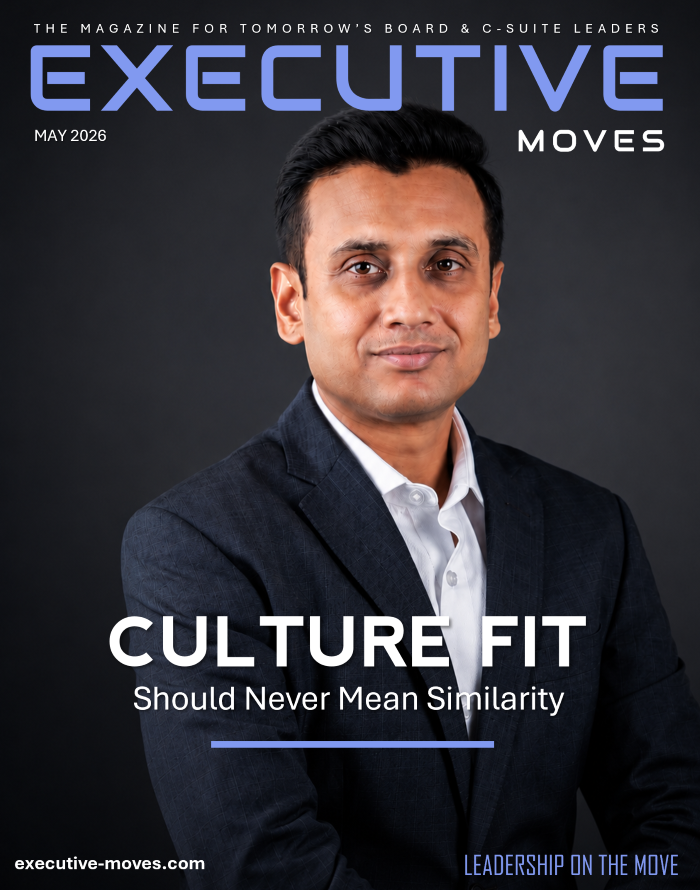
Stanton Chase's new Partner for Consumer Products & Services on why money isn't winning the GCC talent war, why "the leaders who built it won't be the ones to scale it," and what executive search firms may still be getting wrong.
With more than two decades of leadership experience across the Middle East, India and APAC, Rupak Sircar has built a career at the intersection of business transformation, leadership strategy and organisational scale. Having held senior HR and transformation leadership roles across global organizations, he recently joined Stanton Chase as Partner – Consumer Products & Services, Middle East, where he will focus on executive search and leadership advisory across the region’s evolving consumer ecosystem. In this conversation, Rupak shares his perspective on the future of consumer leadership in the GCC, the growing war for senior talent, and why the next phase of growth in the region will depend heavily on leadership quality, adaptability and succession depth.
EM: You spent over two decades inside major organisations - global banks, consumer conglomerates - building leadership and HR functions from the inside. What's the through-line that connects those chapters, and how does it show up in the work you'll do at Stanton Chase?
The common thread across my career has been helping organisations build leadership capability during periods of rapid growth, transformation and change. I have spent years partnering closely with CEOs and boards on scaling businesses, building leadership teams and navigating transformation. That operator experience gives me a very practical lens on leadership hiring and development. Leadership hiring is not simply about filling roles — it is about enabling business outcomes. At Stanton Chase, that perspective will help me bring a more strategic and commercially grounded approach to executive search and supporting clients through leadership advisory.
EM: Why Stanton Chase, and why now? Most senior HR leaders in your position would have stayed on the operator side. What made the move to leadership advisory the right next chapter?
For me, this move is a natural extension of the work I was already doing as a CHRO and transformation leader. Executive hiring, leadership assessment and succession planning had become a significant part of my role over the years. I enjoyed working closely with boards and CEOs on leadership decisions that shaped business outcomes. Stanton Chase appealed to me because it combines strong global executive search capability with leadership advisory expertise. Executive search remains the core of the business and a critical strategic lever for clients, but increasingly organisations also need advice around succession, assessment and leadership transformation. This role allows me to operate at that intersection.
EM: Wharton, India, the GCC, banking, consumer - that's an unusually wide arc. What's one early experience or mentor that shaped how you think about leadership today?
Over the last two decades, I have been fortunate to partner with multiple C-Suite leaders in global organizations and have been a part of their journey though uncertainties, challenges, transformation and growth. This has shaped my belief that leadership is ultimately about building trust and alignment, especially during transformation. It also reinforced for me that leadership potential cannot be assessed purely through credentials or experience; resilience, judgment and adaptability matter just as much.
EM: If you had to name the single biggest shift reshaping consumer leadership in the Middle East right now, what would it be - and why are most boards underestimating it?
The biggest shift is that consumer businesses in the region are moving from expansion-led growth to capability-led growth. In the past, growth was largely driven by market expansion and capital deployment. Today, competitive advantage increasingly depends on leadership agility, digital capability, customer experience and organisational adaptability. Many boards still underestimate how dramatically leadership requirements are changing. The leaders who built successful businesses over the last decade may not automatically be the right leaders for the next phase unless they can evolve quickly.
EM: The GCC is now a real battleground for consumer talent - family-owned conglomerates, multinationals, sovereign-backed giga-projects and PE portfolio companies are all hiring from the same pool. Who's winning that battle, and what are they doing differently?
The organisations winning today are not necessarily those paying the highest compensation. They are the ones offering scale, purpose, empowerment and the opportunity to build something meaningful. Strong consumer leaders today want impact, speed of decision-making and visible growth opportunities. The companies attracting the best talent are also investing more consciously in culture, leadership development and long-term career pathways. In contrast, businesses with slow decision cycles, unclear mandates or purely transactional approaches to talent are finding it harder to compete.
EM: Saudi Arabia is in the middle of an unprecedented consumer build-out - retail, hospitality, entertainment, F&B. Practically speaking, where is the leadership talent going to come from, and what should companies stop doing if they want to attract it?
The scale of transformation underway in Saudi Arabia means leadership demand will continue to exceed supply for several years. The talent will need to come from multiple pools — experienced regional leaders, global executives with emerging market expertise, diaspora talent returning to the region and accelerated development of Saudi nationals. Companies also need to stop thinking of talent attraction as purely a compensation discussion. Senior leaders increasingly evaluate organisations based on culture, leadership quality, empowerment and long-term opportunity. Organisations that fail to create compelling leadership environments will struggle to attract and retain top talent.

EM: Digital, omnichannel, AI, direct-to-consumer - these have moved from buzzwords to non-negotiable competencies. How is the C-suite job description in consumer companies actually changing, and which roles do you see emerging or disappearing in the next five years?
Consumer leadership roles are becoming significantly more integrated and technology-enabled. CEOs and business leaders today need stronger understanding of customer analytics, digital ecosystems, AI-enabled productivity and omnichannel economics. We are also seeing the rise of hybrid leadership roles that combine commercial, digital and transformation responsibilities. At the same time, purely operational leadership profiles without strategic or digital capability will gradually become less relevant. Leadership teams will increasingly be built around adaptability and learning agility rather than narrowly defined functional expertise.
EM: There's a long-running debate in the region about 'localising' senior leadership versus importing global expertise. From where you sit, what's the honest answer, and how should companies be thinking about that balance?
The honest answer is that the strongest organisations will combine both. Local leadership capability is critical because regional consumer markets have their own cultural nuances, customer behaviours and stakeholder expectations. At the same time, there is significant value in bringing in global expertise where it strengthens transformation capability, operating excellence or innovation. The key is not choosing one over the other, but creating leadership teams that combine local understanding with global perspective. Over the long term, the most sustainable organisations will be those that consciously invest in building strong local leadership pipelines.
EM: You've been on the other side of the table, hiring senior leaders into a major consumer group. What do most executive search firms get wrong about consumer mandates in this region, and how do you intend to do it differently at Stanton Chase?
One of the biggest gaps is that many firms still approach executive search too transactionally and too heavily through the lens of previous experience or sector pedigree alone. While relevant experience is important, long-term leadership success depends equally on leadership traits, adaptability, values alignment and cultural fit. Particularly in the Middle East, where organizations operate with highly diverse stakeholder environments and multicultural workforces, cultural alignment becomes critical to leadership effectiveness and sustainability.
Having spent years on the client side, I have seen situations where highly accomplished leaders struggled because the organizational culture, leadership style or stakeholder environment was not the right fit. At Stanton Chase, we go much deeper than conventional search methodologies. Our approach focuses not only on identifying leaders with strong commercial capability and transformation experience, but also on conducting rigorous leadership and cultural assessment to ensure the right long-term fit for both the organization and the individual. That combination is what ultimately drives sustainable leadership success.
EM: CHROs are often the most under-appreciated voice in the executive search conversation. What should CEOs and boards be asking their CHROs that they currently aren't?
Boards should be asking whether their current leadership capability is aligned to where the business needs to be five years from now — not just where it is today. Too often, talent conversations remain operational rather than strategic. CHROs should also be involved much earlier in discussions around growth strategy, succession and transformation because leadership capability is often the single biggest determinant of whether strategy execution succeeds or fails.
EM: What does 'cultural fit' really mean in a region where you might have a Saudi family chairman, a Lebanese CEO, an Indian CFO, a British CMO and a workforce of 60+ nationalities? How do you assess for it without falling into stereotypes?
Cultural fit should never mean similarity. In a multicultural region like the GCC, effective leadership is really about cultural adaptability, emotional intelligence and the ability to build trust across highly diverse stakeholder groups.
I believe organizations should focus far more on cultural adaptability, emotional intelligence and leadership style rather than relying on stereotypes or background assumptions.
At Stanton Chase, we place significant importance on cultural assessment as part of the executive search process because leadership success is rarely determined only by experience and/or technical capability. We look at how leaders influence, communicate, make decisions, navigate ambiguity and align with organizational values and leadership style.
EM: What are the first three things you want to build or change in the Consumer Products & Services Practice in your first 12 months?
First, I want to strengthen Stanton Chase’s position as a leading executive search partner for consumer organisations across retail, hospitality, consumer products, e-commerce and services in the Middle East. Second, I want to deepen relationships with boards, promoters and CEOs so that we become trusted advisors on leadership, not just search partners. Third, I want to expand our leadership advisory capability around succession, assessment and leadership transformation to create more long-term value for clients.
EM: If you had to describe the Stanton Chase difference in consumer leadership advisory in one sentence, to a CEO who has worked with other firms, what would you say?
Stanton Chase combines deep executive search expertise with operator-led business insight, enabling us to help clients identify not just strong candidates, but the right leadership capability for future growth.
EM: Beyond search, where do you see Stanton Chase adding value that consumer organisations are not currently getting from their advisory ecosystem? Board work? Assessment? Succession?
Executive search will continue to remain the core requirement for most organizations, but increasingly businesses also need stronger support in assessing long-term leadership sustainability and succession readiness.
That is where Stanton Chase can add differentiated value — through deeper leadership assessment, succession planning, executive integration and cultural fit evaluation. Helping organizations build leadership ecosystems that are sustainable and future-ready will become increasingly important over the next few years.
EM: Five years from now, what does success look like for the practice, and for you personally?
Success would mean building one of the region’s most respected consumer executive search and leadership advisory practices — recognized not only for strong placements, but for long-term client partnerships and strategic impact. Personally, success would mean continuing to work closely with ambitious businesses and contributing meaningfully to the region’s evolving consumer growth story.
EM: What's one piece of advice you'd give a 35-year-old consumer executive in Dubai or Riyadh today who's quietly ambitious about reaching the C-suite?
Focus on building breadth before chasing titles. The leaders who eventually succeed at the C-suite level are usually those who understand the business holistically — customer behaviour, commercial drivers, operations, people and transformation. Also, become comfortable with ambiguity and continuous reinvention. The next generation of leadership will reward adaptability, learning agility and resilience far more than linear expertise alone.
EM: Outside of work, what keeps you grounded? What are you reading, watching or thinking about that has nothing to do with leadership advisory?
I enjoy reading widely across a wide array of subjects including business, leadership, culture and technology. I also enjoy travelling and observing how consumer behaviour and culture differ across markets. Outside of that, spending time with family and close friends helps create balance and perspective beyond work.