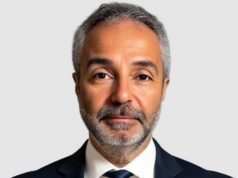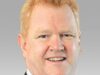


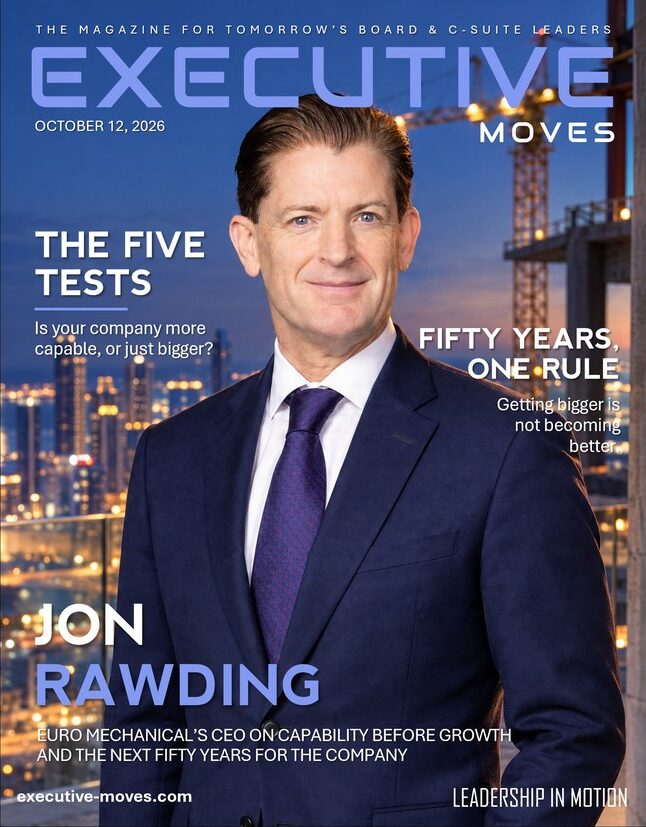
As Euro Mechanical marks 50 years, chief executive Jon Rawding, under whom revenue has quadrupled since 2018, argues that the harder task now is capability: building a company that delivers without depending on the people at the top, himself included.
Jon Rawding's first interview for the top job at Euro Mechanical did not go to plan. He could not find parking, arrived 15 minutes late in the UAE heat with his tie crooked, and told the panel he was probably not the right person. "They disagreed, telling me my CV was that of a CEO and the decision was mine," he told Executive Moves.
He took the job in February 2018. Since then the Emirati engineering contractor, founded in 1976, has quadrupled its revenue. It now has more than 2,000 direct employees across four divisions: Engineering, Procurement and Construction (EPC), Technology Partners, Manufacturing and Services. Rawding joined its board in 2023.
Yet he is more interested in what comes next. As the company marks its 50th year, its strategic reset is about "capability before growth": an organisation that delivers consistently "without relying on exceptional individual effort", including his own. "I sometimes ask myself whether the company could operate effectively if I disappeared for several months," he says. "Where the answer is no, we still have work to do."
The same conviction runs through his book, Learning Beyond Limits (2024), drawn from a career that he says "certainly wasn't carefully planned". Its central idea: "we are all capable of much more than we sometimes believe."
At a Glance
| Name | Jon Rawding |
| Role | Chief Executive Officer, Euro Mechanical, since February 2018; board member since 2023 |
| Company | Emirati mechanical and electrical engineering contractor, Abu Dhabi; founded 1976 |
| People | More than 2,000 direct employees (October 2026) |
| Divisions | EPC, Technology Partners, Manufacturing, Services |
| Since 2018 | Revenue quadrupled (company does not publish figures) |
| Book | Learning Beyond Limits (2024, independently published) |
Purpose First
EM: Since you became chief executive in 2018, Euro Mechanical has quadrupled its revenue. Walk us through how that happened: the decisions that mattered most, and the ones that nearly went wrong.
One of the first things we did was step back and ask ourselves some fundamental questions. Why do we exist? What do we stand for? What do we want to become?
We spent time developing our vision, purpose and brand, creating clarity around what Euro Mechanical represented and where we wanted to go. That gave people something to believe in and a common direction. It also helped us communicate more clearly with our customers and the wider market.
From there, we focused on developing our people, strengthening customer relationships and pursuing opportunities aligned with our direction.
Not everything worked as planned, and we certainly made mistakes along the way. But I believe establishing that sense of purpose and direction was fundamental to the growth that followed.
EM: You had not held a chief executive role before 2018. How did the opportunity come about, and what convinced the owners, and you, that you were ready?
I was headhunted for the position, and my first interview was memorable for all the wrong reasons. I couldn't find parking, arrived 15 minutes late, sweating in the UAE heat, with my tie crooked and my suit looking rather worse for wear.
I actually told the interviewers I probably wasn't the right person. They disagreed, telling me my CV was that of a CEO and the decision was mine.
A month passed without any news. I followed up, looking for feedback, and was invited back.
For the second interview, I was asked how I would double the business. Two CEOs I knew advised me not to make promises about a business I didn't yet understand. Just explain my approach.
I did, and the rest is history. I still had doubts, but I took the opportunity.
EM: What did you find when you arrived, and what did you decide had to change first?
I found a company with a tremendous history, strong customer relationships and people who genuinely cared about the business. There was a great deal to build upon.
What was less clear was our shared direction. Different parts of the organisation had their own priorities, but we didn't necessarily have a common understanding of why we existed or what we wanted to become.
My initial focus wasn't on restructuring the business. It was on bringing people together to develop that shared vision and purpose. I wanted everyone to understand where we were going and feel part of that journey.
Once you establish that clarity, it becomes much easier to align decisions, develop people and create accountability. People need to understand the destination before you start changing how they work.
EM: How do you protect the trust and relationships a long-established business is built on while you change how it works?
I think it starts with respecting what has already been achieved. Euro Mechanical has spent 50 years building relationships with customers, employees, partners and shareholders. Those relationships are an enormous asset, and you don't want to lose them in the pursuit of change.
Equally, relationships alone cannot sustain a growing organisation. You need good processes, clear accountability and sound decision-making. For me, the balance is about preserving the values and personal relationships while strengthening the organisation underneath them.
Communication is particularly important. People need to understand why things are changing, not simply what is changing.
I've also learnt that you don't need to change everything. Some of the most valuable parts of a business are the things that have remained consistent throughout its history.
The Next Fifty Years
EM: Euro Mechanical marks 50 years in 2026. You have said the next stage is less about growth than about capability. What do you mean by capability, and why is it the harder problem?
When I talk about capability, I mean our ability to deliver consistently and sustainably, without relying on exceptional individual effort. It's about having the right leadership, processes, structure, technology and information working together.
Importantly, building capability doesn't necessarily mean adding more people. Sometimes it means doing things differently with the people we already have.
Over the past eight years, we've grown significantly, and that growth has exposed weaknesses in how we operate. Good people often compensate for those weaknesses through experience, relationships and sheer determination. That can work for a while, but it becomes increasingly difficult as the business grows.
Our strategic reset is therefore about capability before growth. If we build a stronger organisation, one that makes better decisions and delivers more consistently, I believe sustainable growth will follow.
EM: What does a company have to keep from its first 50 years, and what does it have to let go of, to be ready for the next 50?
It needs to keep its character. For Euro Mechanical, that's about relationships, trust, commitment to the UAE and an entrepreneurial spirit. Those qualities have been fundamental to our success and should never disappear.
What we need to let go of is the unnecessary dependency on individuals and ways of working that no longer serve us. As businesses grow, knowledge needs to become more accessible, decisions need to be made at the right level, and processes need to support rather than constrain people.
The challenge is finding the right balance. We don't want to become a bureaucratic organisation where every decision requires a committee. We want to retain the responsiveness and personal relationships that built the company, while developing the systems and leadership needed for its future.
I'm a custodian of Euro Mechanical, not its owner.
Jon Rawding
Capability Over Growth
EM: Many companies in the region are judged on how fast they grow. What goes wrong when a business grows faster than its capability? Tell us about a moment you saw that risk up close.
The risk is that the organisation becomes increasingly dependent on individual effort rather than consistent ways of working.
We've experienced this as our EPC business has grown. We have excellent people who overcome challenges every day, drawing on their experience and customer relationships to keep projects moving. But sometimes that can hide weaknesses in our processes and systems.
The warning sign comes when you recognise how much the organisation depends on a relatively small number of people. That's not a criticism of those individuals. Quite the opposite. It demonstrates how valuable they are. But it also tells you that the business needs to become stronger around them.
That's why we're reviewing our end-to-end processes and looking at what a more mature EPC operating model should look like.
EM: Where are you investing most in capability right now: leadership, processes, technology or something else? How do you decide what comes first?
I don't think you can separate leadership, processes and technology. They all need to work together.
Our starting point is understanding how work flows through the organisation. Where are decisions made? Who is accountable? Where do problems occur? What information do people need? Once we understand the process, we can determine how technology can support it.
Leadership is equally important, because even the best systems won't help if people aren't empowered to make decisions.
We prioritise areas where the risks, dependencies or inefficiencies are greatest. For example, we're looking closely at our EPC operating model, including the order-to-cash process.
I'm also encouraging the team not to wait for the perfect solution. Start with something manageable, learn from it and improve as we go. Progress matters more than perfection.
EM: How do you measure whether an organisation is becoming more capable, not just bigger?
I think one of the best indicators is what happens when senior leaders aren't involved. Are decisions still being made? Are problems being resolved? Do people have the information and confidence they need to do their jobs?
I also look at how much time our leadership team spends firefighting. If the same issues keep coming back, we probably haven't addressed the underlying causes.
There are also more traditional measures: project performance, cash flow, predictability, customer satisfaction and employee development.
But ultimately, I believe capability is reflected in the consistency of an organisation's performance. A capable organisation shouldn't need extraordinary effort every day just to deliver what it has promised. And importantly, it should become less dependent on particular individuals, including its senior leaders.
A capable organisation shouldn't need extraordinary effort every day just to deliver what it has promised.
Jon Rawding
People Who Take Ownership
EM: In Learning Beyond Limits you write about how people grow. What is the central idea, and where did it come from in your own career?
The central idea is that we are all capable of much more than we sometimes believe.
My career certainly wasn't carefully planned. I moved between industries, countries and roles, often finding myself in situations where I didn't have all the answers. Looking back, those were frequently the experiences where I learnt the most.
I also came to recognise how much I've learnt from other people, not just those senior to me, but colleagues, employees and people from very different backgrounds. That's really what inspired Learning Beyond Limits. I wanted to share some of those experiences and the lessons I'd taken from them.
My philosophy is relatively simple: remain curious, be open to opportunities, learn from everybody and be prepared to adapt. Growth happens when we're willing to move beyond what's familiar.
EM: What does "taking ownership" look like in practice on a project site or in a delivery team, as opposed to a slogan on a wall?
For me, ownership is about feeling responsible for the outcome, rather than simply completing your assigned task. On a project, that could mean identifying a problem early, communicating it openly, suggesting solutions and following through until it's resolved.
It doesn't mean doing everything yourself. Often, good ownership means recognising when you need help and bringing the right people together. The opposite is waiting for instructions, passing problems between departments or explaining why something is somebody else's responsibility.
But leadership has a responsibility here too. We can't expect people to take ownership if we continually interfere with their decisions or criticise them for trying something different. People need clarity about what they're accountable for, the authority to act and the confidence that they'll be supported when things don't go entirely as planned.
EM: How do you build an organisation that becomes less dependent on its leaders, including you?
You have to become comfortable giving up some control.
Many senior leaders reach their positions because they're good at solving problems. The challenge is recognising that continuing to solve everybody else's problems can actually hold the organisation back.
I increasingly see my role as creating clarity, asking questions, developing people and ensuring the right systems are in place. We need to push decisions closer to where the knowledge sits, while giving people clear accountability and appropriate boundaries.
I sometimes ask myself whether the company could operate effectively if I disappeared for several months. Where the answer is no, we still have work to do.
Ultimately, I would like Euro Mechanical to be successful because of the strength of the organisation, not because it depends on any particular individual.
EM: What have you learned about developing sound judgement in people, rather than simply giving them rules to follow?
I believe judgement develops through experience, reflection and learning from the consequences of decisions. Rules and processes are important, particularly in our industry, but they can't cover every situation. Eventually, someone needs to consider the information available, understand the risks and make a decision.
As leaders, we can help by asking questions rather than immediately providing answers. What do you think? What options have you considered? What could go wrong? What would you do if I wasn't here?
Sometimes their answer will be different from mine, and that's fine. If people can only make decisions when we already agree with them, we're not really developing their judgement.
We need to create an environment where people can make appropriate decisions, learn from mistakes and become increasingly confident in their own abilities.
Building in the UAE
EM: What does building in-country capability in the UAE mean for a business like yours, in talent, suppliers and skills?
For me, in-country capability needs to be about much more than achieving a percentage or meeting a target.
Euro Mechanical is an Emirati company, and the UAE is our home market. We have a responsibility to contribute to the country's long-term development. That means creating genuine opportunities for Emirati talent, developing technical and leadership skills, supporting local suppliers and investing in facilities and manufacturing capability. It also means transferring knowledge and ensuring that expertise remains within the country.
We're particularly interested in developing people who can take on increasingly complex responsibilities as the industry evolves. The UAE has ambitious plans for its industrial and energy sectors, and companies like ours have an important role to play.
Our success should be measured partly by the capability we help create in the UAE, not simply by the revenue we generate.
EM: How has the market for mechanical and electrical contracting in the UAE changed since you took over, and what will it demand of contractors over the next decade?
The market has become increasingly sophisticated, and customer expectations have grown considerably. Technical competence and the ability to execute are still fundamental, but customers now expect much more in terms of project controls, transparency, local capability and commercial discipline. Technology is also changing how projects are designed, managed and delivered.
Looking ahead, I believe successful contractors will need to combine strong local knowledge and customer relationships with increasingly mature operating models. They'll need better information, stronger leadership and people who can adapt as the industry evolves.
For Euro Mechanical, our advantage is our history and relationships in the UAE, together with our understanding of the local market. Our challenge is to ensure the capability of our organisation continues to develop at the same pace as the expectations of our customers.
Looking Ahead
EM: You joined the board in 2023. How has that changed the way you think about the long-term health of the company?
It has encouraged me to look at the business through a longer-term lens. As CEO, you're naturally focused on operational performance, customers, projects and the challenges immediately in front of you. As a board member, you also need to think about the organisation you're creating for the future. That brings greater attention to succession, governance, leadership development, reputation and the sustainability of the business.
It's also reinforced something I feel quite strongly about: I'm a custodian of Euro Mechanical, not its owner. The company existed for more than 40 years before I became CEO, and hopefully it will continue long after I've moved on.
My responsibility is to contribute positively during the time I'm here and leave the organisation stronger, more capable and better prepared for whatever comes next.
EM: When people look back on Euro Mechanical's next 50 years, what would you like them to say this period got right?
I'd like them to say we respected the company's history while having the courage to make the changes necessary for its future. That we didn't confuse getting bigger with becoming better. That we invested in our people, strengthened the organisation and contributed to developing genuine capability within the UAE.
Most importantly, I'd like to think we developed leaders who could make good decisions, take responsibility and help others grow.
I've always believed that leadership is ultimately about what you leave behind. Every generation inherits something from those who came before it, and we have a responsibility to pass something stronger to those who follow.
If this period is remembered as the time we laid the foundations for another successful 50 years, I would be very happy with that.
EM: Please complete this sentence: "A company is ready for its next 50 years when..."
...it can keep learning, adapting and developing people without losing the values that made it successful.
We didn't confuse getting bigger with becoming better.
Jon Rawding
Is Your Company More Capable, or Just Bigger? Five Tests
Drawn from Jon Rawding's answers.
- Take the senior leaders out. Are decisions still made, problems still resolved, and do people have the information and confidence to do their jobs?
- Count the firefighting. How much of the leadership team's time goes on the same issues coming back?
- Check the traditional measures. Project performance, cash flow, predictability, customer satisfaction and employee development.
- Look for consistency. Does the business deliver what it promised without extraordinary effort every day?
- Ask the hard question about yourself. Could the company operate effectively if you disappeared for several months?