


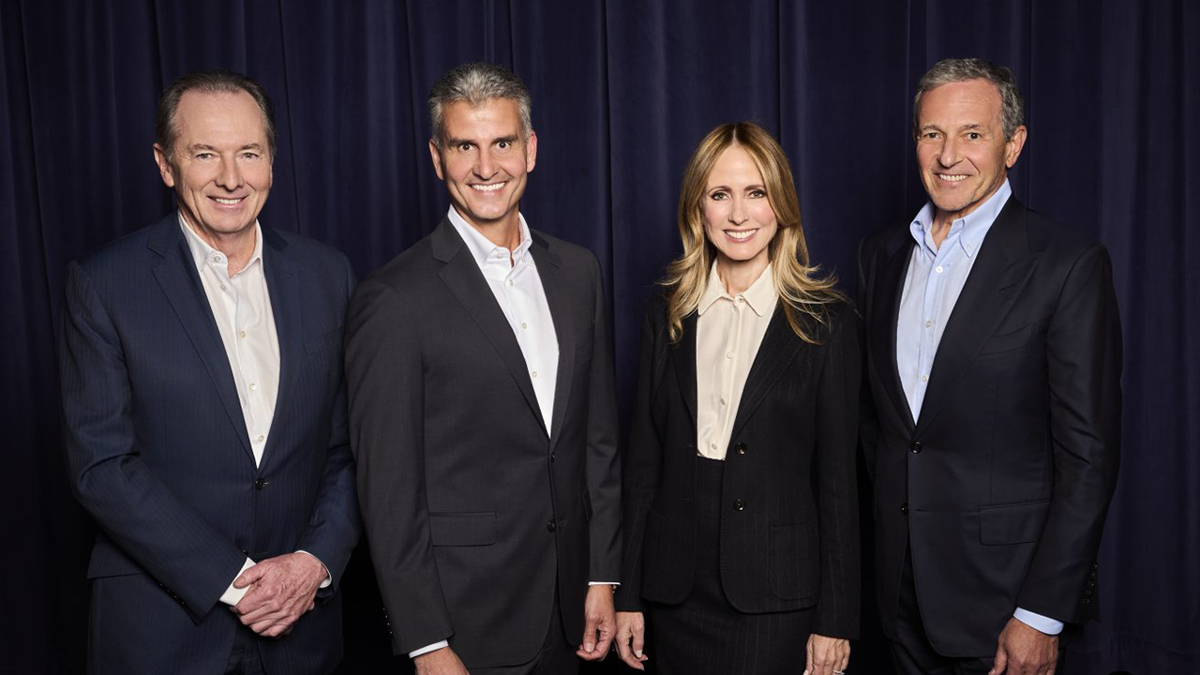
Josh D'Amaro formally became Chief Executive Officer of The Walt Disney Company on March 18, 2026, succeeding Bob Iger after a rigorous two-year succession process that sought to avoid the missteps that defined the company's last leadership transition. D'Amaro, 54, who previously chaired Disney Experiences, the company's largest and most profitable business segment, represents a significant strategic shift toward operations-focused leadership at a sprawling media conglomerate facing persistent challenges in streaming profitability and theatrical distribution. The appointment was announced February 3 after a unanimous board vote, with the company simultaneously elevating Dana Walden to the newly created role of President and Chief Creative Officer, creating a dual leadership structure in which the company's chief entertainment executive reports directly to a CEO whose career has been rooted entirely in theme parks and resorts.
The succession process began in January 2023 when the Disney board's Succession Planning Committee began deliberate evaluations of internal and external candidates over more than two years. Board chairman James Gorman, who was recruited in 2024 after retiring from Morgan Stanley partly because of his succession planning expertise, led the process without external search firm involvement, instead relying on board members' direct engagement and performance assessment of candidates. Outgoing CEO Bob Iger, who provided extensive mentorship to internal candidates and remained available to the board throughout the search, praised D'Amaro's "instinctive appreciation of the Disney brand" and his ability to combine "creativity with operational excellence." Walden, widely considered the front-runner in certain circles, emerged as the primary alternative candidate; her elevation to the new president and chief creative officer role was designed to retain one of Disney's most accomplished entertainment executives while acknowledging that the board prioritized different skill sets for the top job.
D'Amaro spent 28 years at Disney following a brief post-college career as a financial analyst at Gillette in Boston. He initially enrolled at Skidmore College to study sculpture but transferred to Georgetown University after reconsidering whether art could sustain a family, graduating in 1993 with a business administration degree. His Disney career began in 1998 as a strategy analyst at Disneyland Resort, from where he methodically built experience across finance, business planning, operations, and commercial strategy. He served as Chief Financial Officer of Disney Consumer Products Licensing from 2008 to 2010, then led Adventures by Disney before taking the vice presidency of Disney's Animal Kingdom during its Pandora expansion. From 2017 onward, his career accelerated through consecutive presidencies at Disney World and Disneyland, culminating in his May 2020 appointment as chairman of Disney Experiences during the COVID-19 pandemic. In that role, D'Amaro oversaw 185,000 cast members and a 36 billion dollar annual revenue segment spanning six theme parks worldwide, cruise ships, resorts, merchandise, and consumer products, architecting Disney's largest global expansion in its history across Star Wars: Galaxy's Edge, Avengers Campus, and Avatar lands.
The Walt Disney Company generated approximately 94 billion dollars in revenue in fiscal 2025, operating across Entertainment, Experiences, and Sports segments. The Entertainment segment, which encompasses film and television studios, streaming services, and content operations, generated approximately 42.5 billion dollars, while Experiences contributed 36.2 billion dollars. The company operates under a matrix structure with significant decentralization; Disney's streaming operations, encompassing Disney Plus, Hulu, and ESPN Plus, achieved profitability in fiscal 2025 after years of losses. The company has recently announced partnerships with OpenAI and the National Football League and is expanding globally with a new park in Abu Dhabi. D'Amaro's target first-year compensation as CEO is 38.5 to 44.7 million dollars, including a 2.5 million dollar base salary and potential cash bonus of 250 percent of salary, slightly below Iger's 45.8 million dollars in 2025 compensation.
D'Amaro's appointment signals the Disney board's confidence in operational execution over narrative creativity as the primary strategic lever for growth, a decision grounded in the extraordinary profitability of the theme parks division relative to entertainment volatility. Unlike Bob Chapek, who lacked deep parks experience when appointed in 2020 and was ousted after less than three years, D'Amaro carries three decades of institutional knowledge and stakeholder relationships within the company's most stable profit engine. However, his ascension also represents a strategic gamble: that excellence in guest experience economics and capital project delivery can translate to mastery of content creation, talent relations, regulatory affairs, and global media distribution where his experience is limited. Walden's retention in an empowered creative role appears designed to mitigate this risk, creating a partnership model in which D'Amaro handles business operations while Walden retains ultimate creative authority across all entertainment properties. Industry analysts contend that whether this bifurcated structure can deliver the integrated storytelling vision required for Disney's streaming ambitions and franchise interconnectivity remains an open question facing the new leadership.