

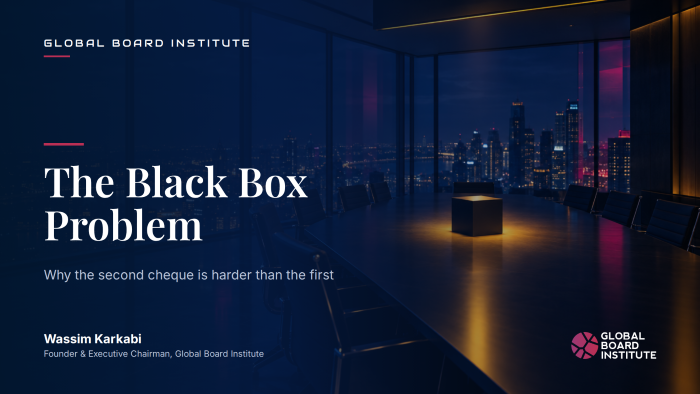
Why the second cheque is harder than the first, and what a small board does about it
By Wassim Karkabi, Founder and Executive Chairman, Global Board Institute
I spent a morning recently with a board adviser who has moved from large corporates to scale-ups, and we compared notes on something we had both noticed. In our region, founders can usually find the first money. It is the second cheque that has become hard. He put a number on it: raising ten million is proving more difficult than raising twenty or thirty, because at twenty or thirty there is revenue and structure underneath. I put a name on it. The black box.
1. The black box
The pattern is familiar to anyone who has invested in early-stage companies here. A founder raises a round from a handful of investors who are excited by the product and the person. The money goes in. Then the updates stop. Twelve or eighteen months later the founder returns and says, I need more money. The investors say: we just gave you money. Where did it go? The answer is vague, and the round stalls.
I have been personally involved in more than one of these. In one, the founder died suddenly and the board, such as it was, disappeared with him; nobody could say what had happened to the product or the money. In another, the founder left the country, handed back the assets and closed the office. In neither case was the problem fraud. The problem was that nobody had been keeping the investors up to date, keeping clean books and sharing information: all the things that allow an investor to say, this person is doing the right thing, heading in the right direction, we can give them more.
That is the biggest stressor on founders looking for money, and it is not the pitch. It is the absence of a structured approach to reporting, transparency and financial governance. Otherwise it is a black box, and nobody funds a black box twice.
2. The board nobody asks for
Here is what puzzles me. Give a large amount to a business and you will, quite rightly, say: I want a board observer in the room to understand what you are doing and report back to me. You will ask for a seat. Give a smaller amount to a smaller business and you get a WhatsApp group.
Yet the smaller companies are the higher risk. The bigger ones are more structured anyway and have people to do a lot of things; the small ones do not. I would have thought that a body of sorts, call it a board or call it what you like, that manages how the money is spent would be a usual part of any fundraising structure. In our region it is still the exception.
Investors are starting to learn this the hard way. The adviser told me that the venture investors he has spoken to in recent months now ask him directly, before any introduction, whether he will sit on the board of the company and help build it, or whether he is just the middleman. They make it a condition. A board, even a small one, keeps everybody in check, on both sides of the room, and the relationship between founder and investor becomes better managed.
The founder gains something too. When the person going out to raise can say, we have a board that will keep you updated and keep the founder honest, the conversation with the investor changes.
3. One hour every week
Let me describe one that works. A founder I know is exceptional at his product and at selling it. What he could not see was the rest: the P&L, the balance sheet, the cash flow, the cap table, the fundraising, the channel. His request was simple. I need the stuff that I can't see. Can you just be there?
So we created a small board around the gaps. Someone for financial governance. Someone with constant contact with investors, for the fundraising. Someone who had run channel sales at a large technology company. Later, a former chief financial officer who understands sales organisations. Four people.
We meet for one hour every week, at the same time, and see where we stand. He asks for advice. Some of us roll up our sleeves: help the channel manager, help the accounting team, prepare the dashboard for the board. The only week we skip is when he has a client meeting.
At this size, board work is not a quarterly ritual. It is operational and advisory, and it does exactly what he asked for: it keeps him honest and on point. Eighteen months in, the business is growing well, and the investors know precisely what is happening to their money.
4. Design the board so it can change
Two design choices make this kind of board work. The first is tenure. Everybody gets a two-year contract with an exit clause on both ends: the founder can say, thank you, you are not adding value, and the director can say, this is not a good fit for me. Either way, people can leave without drama. But the two years are a real commitment. Put everything in, grow the company to the next level, and then decide together whether to renew or refresh some or all of the seats, depending on where the company has moved to.
The second is fit. The director who is superb at the chaos of zero to one is often not the person you want for the discipline of one to two. It depends on what they enjoy and what they are good at. A proper board is designed for the stage the company is at, not collected from whoever is available. It could be two people. It could be five. Fractional, part-time, senior, and paid for the value they add rather than the hours they sit. The founder gets people who have done it before, without hiring full-time executives it cannot yet afford.
We are building exactly this as a service: a roster of vetted directors, a short diagnostic of the stage and the gaps, a recommended number of seats and a cadence, and a fee that pays everybody for a board that is fit for purpose.
5. A word to directors
If you are an experienced executive thinking about board work, this is where a great deal of the interesting work now is. It is hands-on, it is weekly, and it is not glamorous. It is also, in my experience, better rewarded than it looks. On the boards where I came in at ground level I took equity rather than a fee, and the value of that grows tremendously as the company passes the one, the two and the ten million marks. It is a completely different proposition from a retainer, and it aligns you with the founder in a way a fee never will.
It also requires a different mindset from the large-company board. You will be asked to help the accountant this week and the channel manager next week. If that is beneath you, this is not for you. If you enjoy building, there are few better seats.
What this means
For founders: the second cheque is won or lost on the reporting you did after the first. Clean books, a rhythm of updates, and a small board that keeps you honest are not the price of raising money. In this region they are increasingly the way you raise it.
For investors: ask for the board on the small cheques, not only the large ones. The risk is higher there, not lower, and a fractional board costs a great deal less than the money that disappears.
For directors: the most useful thing a network of board members can do for one another is to be there. When one of our members travels to another city on business and needs advice, the first question should be, who in our chapter there is willing to have a coffee? Putting board directors together brings more business to everybody. It also means that somewhere, right now, a founder is being kept honest by someone who chose to just be there.