

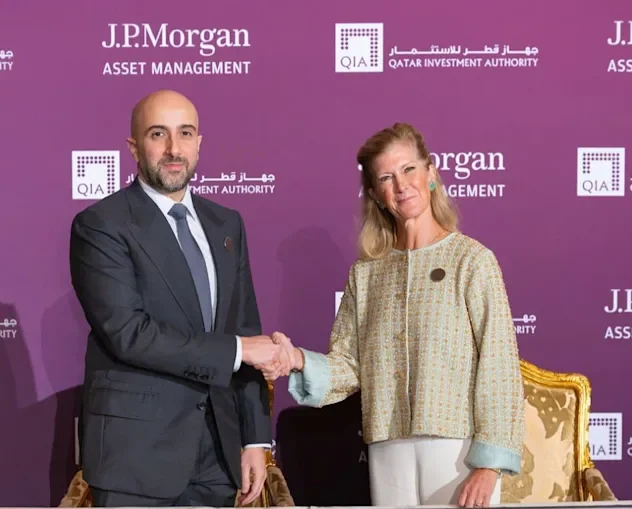
The Qatar Investment Authority has agreed a $20 billion strategic partnership with J.P. Morgan Asset Management, the two sides announced on 21 September 2026. The tie-up, set out in a memorandum of understanding, is one of the largest asset management partnerships struck by a Gulf sovereign wealth fund and deepens the relationship between Qatar sovereign investor and one of the world biggest money managers.
The partnership is structured in two parts. Around $15 billion will sit in a customised global equities mandate managed by J.P. Morgan Asset Management on behalf of the authority. The remaining $5 billion will fund a private markets vehicle that provides senior financing to middle market companies in the United States, targeting sectors including industrials, business services, healthcare and technology. The split gives the authority both liquid, actively managed public market exposure and a direct route into private credit at scale.
The Qatar Investment Authority, which manages assets estimated at around $530 billion, has been steadily expanding its partnerships with large global financial institutions as it diversifies its portfolio and builds exposure to private markets. The new arrangement follows a similar large partnership the fund agreed earlier with Goldman Sachs, and it fits a wider pattern among Gulf sovereign funds of channelling capital through managed mandates and co-investment structures rather than relying solely on in house teams.
The move carries significance beyond the headline number. For J.P. Morgan Asset Management, securing a mandate of this size from a major sovereign investor is a strong endorsement of its public and private markets platform at a time when the largest managers are competing hard for sovereign capital. For the authority, concentrating a large allocation with a single manager brings scale, negotiating power and a deep bench of investment capability, while the private credit sleeve gives it access to a fast growing asset class that has drawn heavy institutional demand as banks have pulled back from parts of corporate lending.
The partnership also underlines how Gulf capital is increasingly being deployed into the United States middle market, where private financing has become a core part of how mid sized companies fund growth. As sovereign funds seek durable, income generating exposure outside public equities, arrangements that pair a customised equities mandate with a dedicated private credit vehicle are likely to become a more common template. The memorandum of understanding sets the framework for the partnership, with the two institutions to build out the mandates from here.