

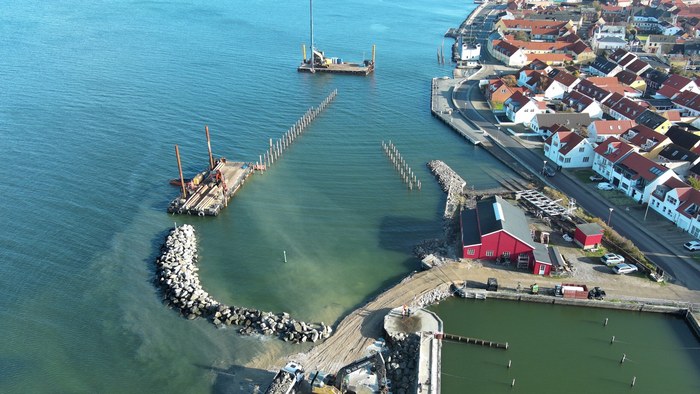
CG Jensen has begun main contractor works on a new marina and coastal flood protection scheme at Loegstoer harbour on the Limfjord in northern Denmark. The client is Vesthimmerlands Kommune, which has commissioned the berths and the sea defences as a single scheme rather than as two separate projects.
The contractor states that the works will add between 65 and 70 new boat berths, sheltered behind a new 380 metre outer breakwater mole. That mole is being built 30 centimetres higher than the existing harbour protection and finished with a pile founded mole head, with a pile founded timber boardwalk running the full length of its landward side. The bill of quantities runs to twelve cap blocks weighing up to 24 tonnes each, 50,000 tonnes of Norwegian quarry stone and six kilometres of Greenheart piles, alongside dredging and deepening of parts of the harbour basin. Water, lighting and card payment systems for electricity are being installed to the piers, and land based toilet facilities are being built for visiting crews. Vertical drains installed from a pontoon are being used to speed consolidation of the soft seabed soils before the heavier stonework goes on top of them.
One figure is not settled on the published record. The narrative description gives four new floating piers while the specification list on the same page gives two, and the issuer does not reconcile the two statements, so the pier count is reported here as contested rather than as a number.
What shapes this programme is not the engineering but the calendar around it. Noisy work is permitted only until the end of March, after which the quieter timber elements have to carry the schedule, and the site sits beside a Natura 2000 protected area in a town whose economy leans heavily on a short summer season. That combination turns a straightforward marine civils job into a sequencing problem, which is why the heavy stone placement and piling are being pushed hard in the winter months while the permission window is open. Completion of both the marina and the flood protection is planned for the end of 2027.
The pairing of leisure berths with a raised sea defence is becoming the standard form for Danish harbour investment rather than an unusual one. Limfjord towns face the same rising surge exposure as the rest of the Danish coast, and a mole that has to be built anyway for storm protection is considerably cheaper to specify as a marina breakwater at the same time than to retrofit later. The commercial logic is that the flood protection is the obligation and the berths are the return on it, which is how a municipality of this size finances coastal defence at all.