

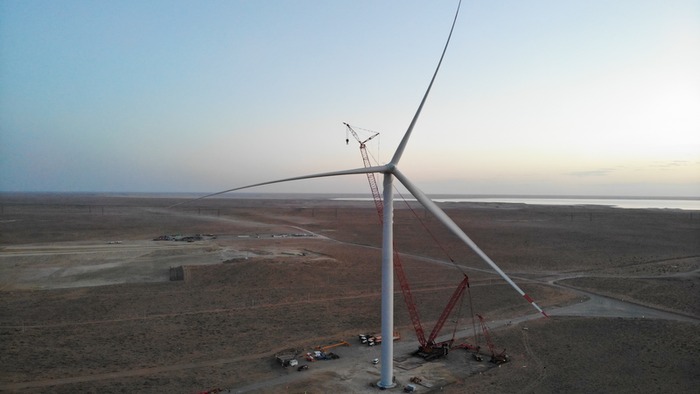
ACWA Power has reached financial close on the Bash II wind farm in Uzbekistan's Bukhara region, the Saudi utility developer told the Saudi Exchange on 15 November.
The financing totals 847.5 million riyals, which the filing puts at about 226 million dollars, with a tenor of 21 years. The lender consortium comprises the Asian Development Bank, the Asian Infrastructure Investment Bank and Standard Chartered Bank.
ACWA Power said its guarantees are limited to its standby equity and reserve account commitments, which it described as prevailing market practice for limited recourse renewable projects in Uzbekistan. The company stated there are no related parties to the transaction. The filing as summarised does not state the project's capacity, total cost, equity split, offtaker or power purchase agreement term, and no construction start or commercial operation date was disclosed. Separate trade reporting on the same close describes the asset as a 300 megawatt wind farm, a figure that does not appear in the exchange filing itself.
Uzbekistan has become the largest market outside the Gulf in ACWA Power's renewables pipeline, and the structure of this package says something about how that position is being funded. A 21 year limited recourse facility from two multilateral development banks alongside a commercial lender indicates that institutional capital remains willing to take long dated Central Asian offtake risk, at a point when several emerging market renewable programmes have struggled to attract tenors of that length.
The limited recourse structure matters for the developer as much as for the lenders. By capping its exposure at standby equity and reserve commitments, ACWA Power keeps the project debt off its own balance sheet, which is the model it has been pressing to replicate across its international portfolio as the pipeline grows faster than its equity base. The presence of the development bank and the infrastructure bank also brings a layer of political risk comfort that a purely commercial consortium would price differently.
For Uzbekistan, the close continues a run of Gulf backed generation capacity reaching financial completion rather than stalling at announcement. That distinction is the one worth watching: the country has signed a considerable volume of renewable memoranda in recent years, and the proportion that converts into funded construction is the better measure of whether the programme is working.