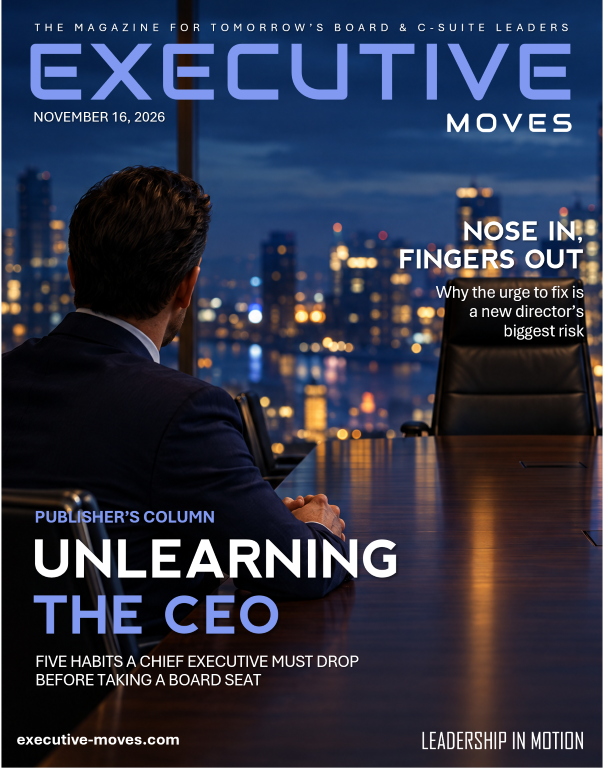
The habits that win the top job are the same habits that make a poor director. Before a chief executive takes a board seat, there are five things to stop doing, and one thing to keep.
By Wassim Karkabi, Founder and Executive Chairman, Global Board Institute
Boards like to recruit chief executives, and for good reason. Spencer Stuart's 2026 U.S. Board Index found that, as in the previous year, most incoming S&P 500 directors bring CEO or financial experience. A sitting or former chief executive knows what it costs to deliver a forecast, how a strategy dies in the middle of an organisation, and what management will not say in a board pack.
Yet the transition from the corner office to the boardroom is harder than it looks, and the reason is not a lack of ability. It is that the role asks you to give up most of what made you successful. A chief executive's authority is personal. A director's authority exists only when the board acts together. Everything else follows from that difference.
1. Stop answering. Start asking.
For years your value was in having the answer, or at least in making the call when no one else would. In the boardroom, the most useful thing you can bring is the question management has not yet asked itself. "What would have to be true for this plan to work?" does more good than a better plan of your own. A director who arrives with solutions turns the meeting into a contest with the chief executive, and the chief executive will win it, because they have the information and the team.
2. Stop owning the outcome. Own the oversight.
As a chief executive, you owned the result. As a director, you share accountability with the whole board for whether the company is well led, well governed and honestly reported, but you have no individual authority to make anything happen. That combination is uncomfortable for people used to pulling levers. The discipline is to ask whether the board has the right chief executive, the right plan, the right risks in view and the right information to judge all three. If the answer to any of these is no, the remedy is a board decision, not a personal intervention.
A chief executive's authority is personal. A director's authority exists only when the board acts together.
Wassim Karkabi
3. Stop running the meeting.
Chief executives are used to setting the agenda, framing the discussion and closing it. In the boardroom, the chair does that. You are one voice among several, and often not the most expert one on the topic in front of you. The best new directors speak less in their first year than they expected to, and make what they do say count. The worst treat every agenda item as a chance to show they could run the company better.
4. Stop fixing.
The old governance maxim is "nose in, fingers out". It is easy to agree with and hard to practise, especially for someone who has spent a career fixing things. When you see a problem in a business you know well, the instinct is to call the executive who owns it and help. That help, however well meant, undermines the chief executive's authority and blurs who is accountable. Raise it in the boardroom, or with the chair. Then let management manage.
5. Stop relying on your own sources.
As chief executive, you had the whole organisation as your information system. As a director, you have the board pack, the committee papers and whatever management chooses to present. The temptation is to go around this, through old contacts, informal calls and your own reading of the market. The better course is to insist that the board receives what it needs: clearer papers, earlier warnings, direct access to the people below the executive committee through proper channels. A board that has to work around its own information has a governance problem, and it is the board's job to fix it in the open.
The one thing to keep
None of this means leaving your experience at the door. What a chief executive brings to a board is judgement about people, a sense of when a number is too good, and an instinct for the risk that is not on the register. Those are rare, and boards need them. The point is to offer them as a director: through questions, in the room, as part of a collective decision.
The chief executives who make the best directors are the ones who understand that the job is not a smaller version of the one they had. It is a different job. The sooner they unlearn the old one, the sooner they are good at the new one.