

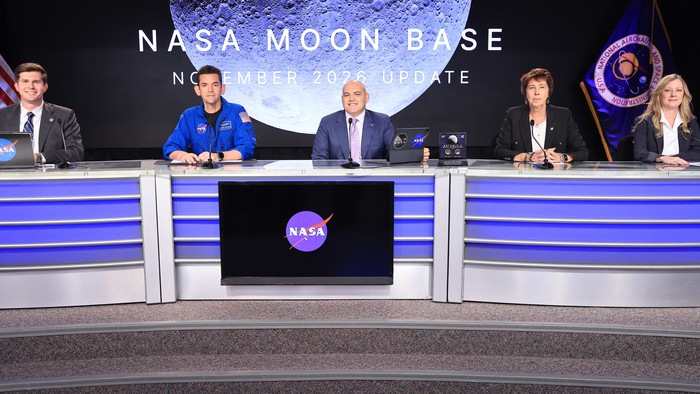
NASA has opened the second generation of its Commercial Lunar Payload Services programme to eight companies under a ten year contract with a combined maximum value of ten billion dollars. The agency announced the award on the seventh of November at an aerospace exposition held at its Kennedy Space Center in Florida.
The eight selected companies are Blue Origin, Firefly Aerospace, Intuitive Machines, ispace US, Lockheed Martin Space, Northrop Grumman Space Systems, SpaceX and Voyager Technologies. The structure is a multiple award indefinite delivery, indefinite quantity contract, so the ten billion dollar figure is a ceiling against which individual delivery orders are placed rather than a sum committed to any supplier.
The agency also raised the ceiling on the first generation of the programme from two point six billion dollars to four point two billion. That earlier contract remains in place through November of 2028, with a further five years allowed to complete deliveries already awarded, running to November of 2033. Separately the agency placed six task orders worth about one point three billion dollars combined under a launch services contract whose own ceiling is five billion dollars, and awarded a lunar rover task with a ninety four million dollar base value and a one hundred and forty million dollar option, targeted for launch in late 2028 on an eighteen month mission.
Two things in the structure are worth reading carefully. The first is that raising the old ceiling while opening a new one keeps both vehicles live at once, which lets the agency keep placing orders with incumbent suppliers while the new competition establishes pricing. The second is that a ceiling is not a budget. An indefinite quantity contract transfers the planning risk to the supplier, which has to carry development and production capacity against orders that may never be placed, and that is why a headline ceiling of this size tells you more about the agency's intent than about money that will be spent.
For the suppliers the award is a qualification rather than a payday. Eight companies now hold the right to bid for delivery orders, and the commercial outcome will be decided by which of them can fly reliably and at what cost per kilogram delivered to the lunar surface. The agency has said it expects to issue a separate solicitation for integrated surface power systems in early 2027.