


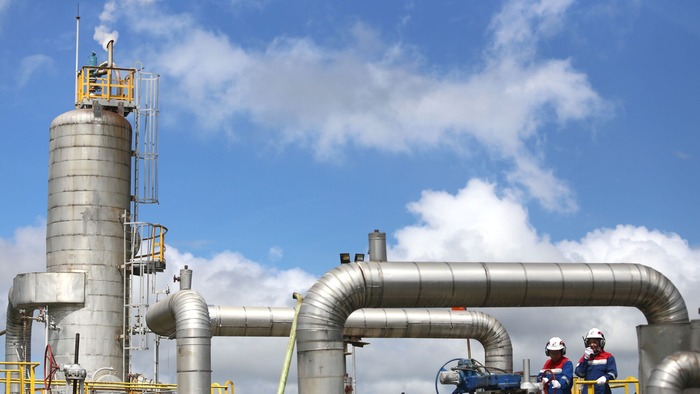
XRG, the international energy and chemicals investment arm of ADNOC, has completed the acquisition of a 12.5 per cent stake in Southern Gas Corridor CJSC, the Azerbaijani state company that holds the country's interests in the pipeline system carrying Caspian gas to Europe. The shareholders' agreement was signed on 14 September 2026 between the Ministry of Economy of the Republic of Azerbaijan, acting on behalf of the Republic, and XRG SGC Limited, according to statements published the same day by Southern Gas Corridor CJSC and the Azerbaijani presidency.
The transaction changes the shape of the holding company's register. Southern Gas Corridor CJSC was founded with the State holding 51 per cent and SOCAR holding 49 per cent. As of September 2026 it is held 36.5 per cent by the State, 51 per cent by SOCAR and 12.5 per cent by XRG SGC Limited. In other words, the sovereign has reduced its direct holding while the national oil company has moved into majority control and a Gulf investor has taken a minority position alongside both.
No financial terms were disclosed by any party. ADNOC has said that XRG carries an enterprise value exceeding 80 billion dollars. The trade publication World Pipelines reported a comment attributed to Mohamed Al Aryani, President of International Gas at XRG, that "This completion is a defining step in the development of XRG's integrated Caspian strategy." That remark was carried by the trade press rather than issued directly by XRG.
The significance for European energy security is structural rather than volumetric. A Gulf sovereign-backed investor now sits inside the ownership of the vehicle holding Azerbaijan's interests in the principal non-Russian pipeline route into southern Europe. On the reading of this publication, and this is an inference rather than a stated intention of any party, that aligns the commercial incentives of an Abu Dhabi investor with the continued operation and potential expansion of that route, and it introduces a shareholder whose capital base is not dependent on European credit conditions or European policy cycles. It also gives the Azerbaijani state a partner for capital expenditure without recourse to the sovereign balance sheet, which is the most plausible explanation for accepting dilution from 51 per cent to 36.5 per cent while SOCAR moves to 51 per cent. No party has characterised the rationale in those terms.
What boards should do with this depends on exposure. Utilities, industrial gas buyers and energy-intensive manufacturers with southern European supply should treat the transaction as a reason to revisit counterparty and route concentration analysis, not because supply terms have changed, since none were announced, but because the ownership and therefore the governance of a route they rely on has changed. Procurement teams negotiating multi-year gas contracts should ask what the new shareholder structure means for investment decisions on the corridor over the contract term. Infrastructure investors and lenders should note the precedent: Gulf capital is now buying minority positions in the midstream assets of transit states rather than only in upstream production, and boards evaluating similar assets should expect to compete with that capital rather than assume it is absent. The observable indicators to track are further Azerbaijani asset sales, any additional XRG commitments in the Caspian, and whether European buyers respond by seeking direct participation of their own.