

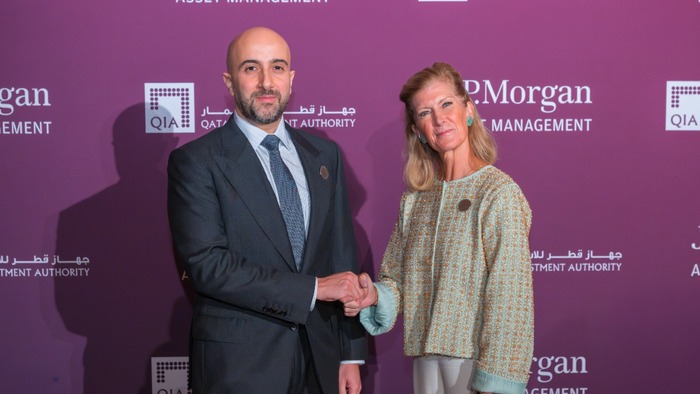
The Qatar Investment Authority and J.P. Morgan Asset Management have announced a strategic partnership worth 20 billion dollars, the asset manager said on 21 September 2026.
The commitment splits into two parts. A 15 billion dollar mandate will be invested in public equities. A further 5 billion dollars is directed at a private markets initiative focused on United States middle market companies.
Mohammed Saif Al-Sowaidi, chief executive of the Qatar Investment Authority, said the fund was pleased to grow its partnership with J.P. Morgan Asset Management and gain access to one of the world's leading global equity and private credit platforms. Mary Callahan Erdoes, chief executive of J.P. Morgan Asset and Wealth Management, said the firm would support the authority's role as a leader in global institutional investing by drawing on capabilities across public and private markets.
J.P. Morgan Asset Management reported assets under management of 4.6 trillion dollars as at 30 June 2026. Its parent, JPMorgan Chase and Co., reported total assets of 5.0 trillion dollars and stockholders' equity of 375 billion dollars on the same date.
A pattern, not a one off
The structure matters more than the headline figure. The authority is not acquiring assets directly here. It is buying access to a platform, and a segregated public equities mandate of this size alongside a private markets sleeve is the behaviour of an asset owner choosing to externalise implementation rather than build further capability in house.
Read against January, the direction becomes clear. On 20 January 2026 the authority signed a memorandum of understanding with Goldman Sachs targeting 25 billion dollars into Goldman Sachs Asset Management funds, co-investments and direct investments. In that announcement Al-Sowaidi named artificial intelligence, financial technology, digital infrastructure and private credit as target sectors, and Goldman Sachs said it would expand its Doha office into its largest regional asset management hub. Taken together, the two mandates commit 45 billion dollars of Qatari capital to two United States managers inside nine months.
What to watch
The wording around the private markets sleeve repays attention. The combination of United States middle market exposure and Al-Sowaidi's explicit reference to private credit points towards direct lending rather than buyout equity, although neither release uses that term. If that reading is right, Gulf sovereign capital is moving into the fastest growing and least cycle tested part of the United States credit market, and it is doing so five days after the Federal Reserve raised rates for the first time since 2023. Higher policy rates lift coupon income on floating rate private credit and raise default risk among the same borrowers.
Three things will show whether the model spreads. The first is whether J.P. Morgan follows Goldman Sachs in building out Doha, which would move senior asset management roles from London and New York to the Gulf. The second is whether the authority discloses anything about fee or performance terms, which at this scale are material to both managers. The third is whether the Public Investment Fund in Saudi Arabia and Mubadala Investment Company in Abu Dhabi answer with comparable platform deals of their own.
The authority does not publish an assets under management figure, and none appears in either release.