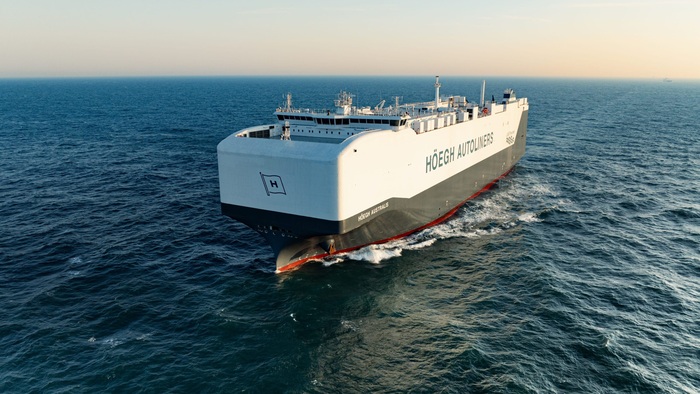
Høegh Autoliners has agreed to install marine battery systems on Aurora No. 12, a deep sea car carrier the company says will be the first to combine battery storage, a shaft generator, solar panels and ammonia fuel in a single integrated system. The agreement was announced on 9 November 2026 and signed at the China Pavilion at COP31.
The batteries are supplied by BYD Energy Storage. The vessel is due for delivery and commercial service in May 2028, and the owner says it will run on ammonia from the day it leaves the yard. The company expects the integrated system to cut about 1,000 tonnes of carbon dioxide equivalent a year, a figure it presents as an expectation rather than a measured result.
Aurora class vessels each carry up to 9,100 cars and are built by China Merchants Heavy Industry. The owner states that the class cuts carbon emissions by up to 58 per cent against conventional pure car and truck carriers, and that the ships hold ammonia ready and methanol ready notation from their classification society.
In August 2026 the operator ordered six further vessels, taking the programme to eighteen ships, with options and slot reservations that could extend it to twenty six. Those six are scheduled for delivery between 2029 and 2031.
The notable part of this agreement is not the ammonia, to which the company has been publicly committed for several years, but the stacking of systems around it. Batteries, a shaft generator and solar panels all attack the same target, which is the auxiliary load a car carrier draws while manoeuvring and at berth. Ammonia addresses the main engine; the rest addresses everything else. An owner that solves only the fuel question still burns conventional power for ventilation, ramps and hotel load on a ship type where cargo decks must be ventilated continuously.
Sourcing the batteries from a Chinese automotive group is also a commercial signal. The supplier is a manufacturer of the vehicles that car carriers exist to move, so a supply relationship of this kind sits alongside a cargo relationship. Deep sea vehicle carriers have limited room to differentiate on anything other than reliability and emissions performance, and a visible technology partnership with a major shipper is a way of competing on both at once.
Scale is what decides how much a single ship matters. The operator moves roughly 1.6 million car equivalent units a year and says it will be ready to sail net zero from 2027, the year of its centenary. One vessel delivering in 2028 does not move that arithmetic by itself. An eighteen ship programme with options to twenty six does, and every system proven on one hull is one fewer unknown when the remainder of the series is specified.