

We read every chief executive appointment we reported last quarter to answer one question: did the board promote from within, or hire from outside? In the United States, 22 of 39 top jobs went to insiders. Everywhere else, the pattern reversed.
Between 1 July and 30 September 2026, Executive Moves reported 106 appointments to the top job of a company or organisation, from Apple and General Mills to Oman Air and the Church Commissioners for England. (We left out heads of divisions, regions and country businesses, deputies and board seats, and counted each person once.)
For each one, we went back to our own story and recorded where the new chief executive came from. The result is a clear divide.
The headline numbers
- 44 insiders, 53 outsiders. Of the 106, 44 were already working for the organisation or its parent group (42%), and 53 came from another organisation (50%). One was a founder. For eight, our story did not say enough to tell.
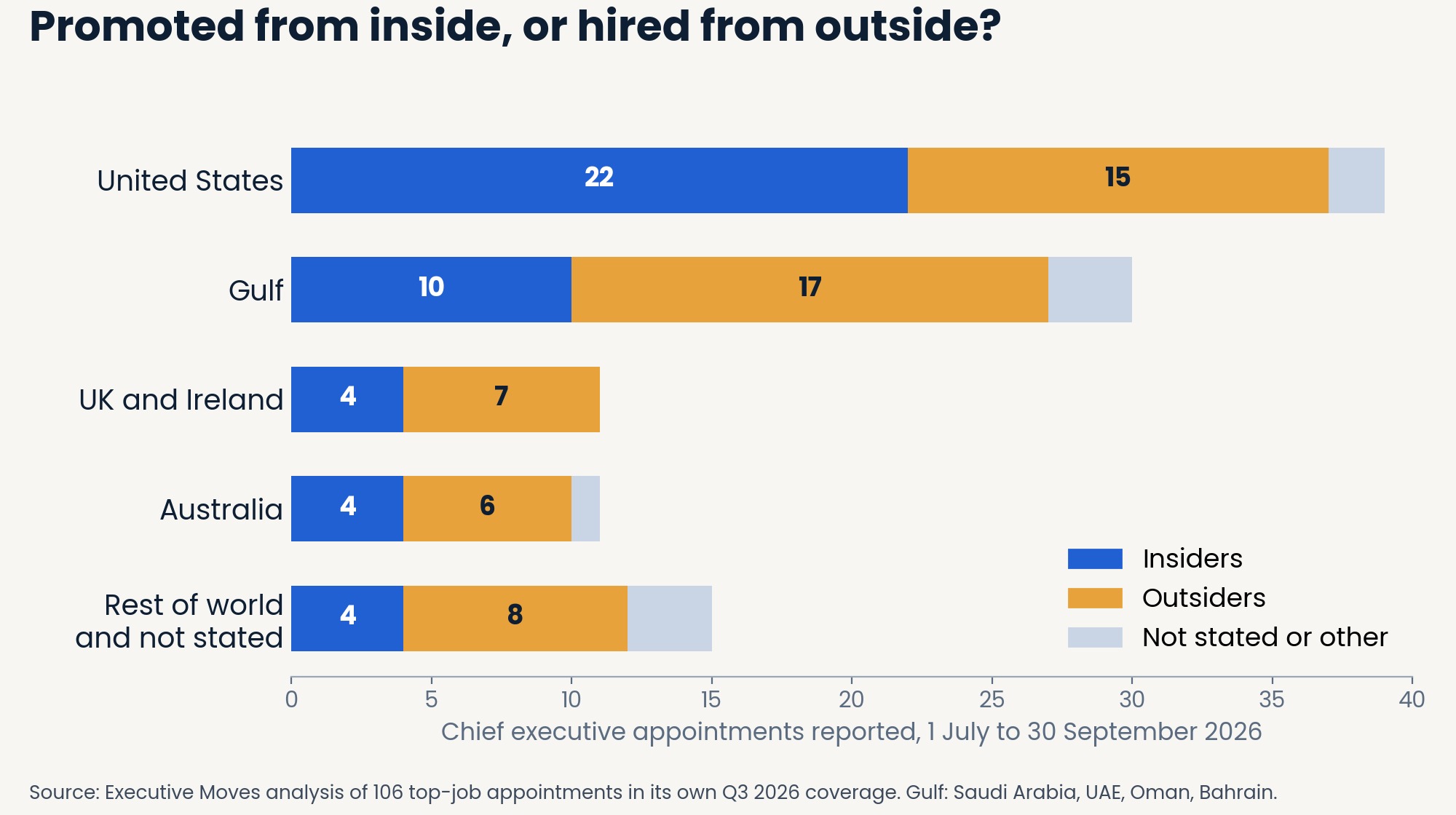
- The United States promotes. Of the 39 US appointments, 22 went to insiders and 15 to outsiders. Where the origin was known, insiders took about three in five.
- The rest of the world recruits. Across the other 67 appointments, outsiders outnumbered insiders by 38 to 22. Where the origin was known, outsiders took nearly two in three.
- The Gulf leans hardest outside. Of 30 appointments in Saudi Arabia, the UAE, Oman and Bahrain, 17 went to outsiders and 10 to insiders.
| Where the organisation is based | Appointments | Insiders | Outsiders | Not stated or other |
|---|---|---|---|---|
| United States | 39 | 22 | 15 | 2 |
| Gulf (Saudi Arabia, UAE, Oman, Bahrain) | 30 | 10 | 17 | 3 |
| UK and Ireland | 11 | 4 | 7 | 0 |
| Australia | 11 | 4 | 6 | 1 |
| Rest of world and not stated | 15 | 4 | 8 | 3 |
| Total | 106 | 44 | 53 | 9 |
What it says
America's biggest boards grow their own. The quarter's largest US handovers were almost all internal. Apple chose John Ternus, its senior vice president of hardware engineering. ConocoPhillips chose its chief financial officer, Andy O'Brien. Danaher chose Julie Sawyer Montgomery, its executive vice president for Diagnostics. General Mills, The Hartford, Adobe, Curtiss-Wright, L3Harris Technologies and AllianceBernstein also promoted from within. Our US figure sits close to the broadest benchmark: Spencer Stuart's analysis of 2025 transitions put insiders at 60% of new chief executives across the S&P 1500, and 73% in the S&P 500.
Outsiders arrive with experience; insiders get their first chance. Of the 53 outsiders, 34 had held a chief executive title before, according to our stories. Among insiders it ran the other way: 21 were stepping up to the top job for the first time, against 8 who had held the title before. Boards that go outside tend to buy a track record. Boards that promote tend to bet on a person they already know.
The usual route up is operations, not finance. Among the 44 insiders, 11 had been company presidents or had run a division, region or business line, and 8 were chief operating officers. Only 4 came from the finance chair. Nine had been doing the job on an interim or acting basis and were confirmed in it, including Dr Yousif Al Hammadi at Tabreed, Rosie Slater-Carr at the Church Commissioners and Muteab Altukeas at Dallah Healthcare.
In the Gulf, "outside" often means next door. Many of the region's outside hires moved between organisations linked to the same state or investor. Oman Air's new chief executive, Nasser Al Sharji, came from leading Transom Handling and acting as chief executive of Oman Airports Management Company. The Saudi Tourism Authority appointed a deputy minister from the Ministry of Tourism. These moves count as external in our table, but they look more like a leadership pool being rotated across a national portfolio than a search of the open market.
What it means for boards
Neither route is right in itself. An insider knows the culture and the people, and the board knows the insider. An outsider can see what the organisation has stopped noticing. The risk is choosing by habit rather than by need. A board that always promotes may be confusing loyalty with readiness. A board that always recruits may be admitting that it never built a bench.
The question worth asking is not "inside or outside?" It is whether the board had a real choice: at least one credible internal candidate, tested against the market. On our numbers, outside the United States that choice is still the exception.
Method
We took every story in the Appointments section of executive-moves.com dated 1 July to 30 September 2026 with "chief executive" or "CEO" in the headline (151 stories, all retrieved). We kept appointments to the top job of a whole company, group or public body, including interim and acting appointments and co-chief executives, and removed heads of divisions, subsidiaries, regions and country businesses, deputies and board appointments. One appointment reported twice (ROSHN Group) was counted once, and one sitting chief executive reappointed after a short retirement break (Alujain) was not counted as a new appointment, leaving 106.
"Insider" means the story shows the person was employed by the organisation or its parent group immediately before, including interim chief executives confirmed in the role. "Outsider" means they came from another organisation. Where our story did not say, we recorded the origin as not stated rather than guess. Classifications were made from our own stories and checked by hand for the named examples. Country is where the organisation is headquartered.
These figures describe what Executive Moves reported, not the whole market. The regional groups are small, so the percentages should be read as a pattern, not a precise measurement.