

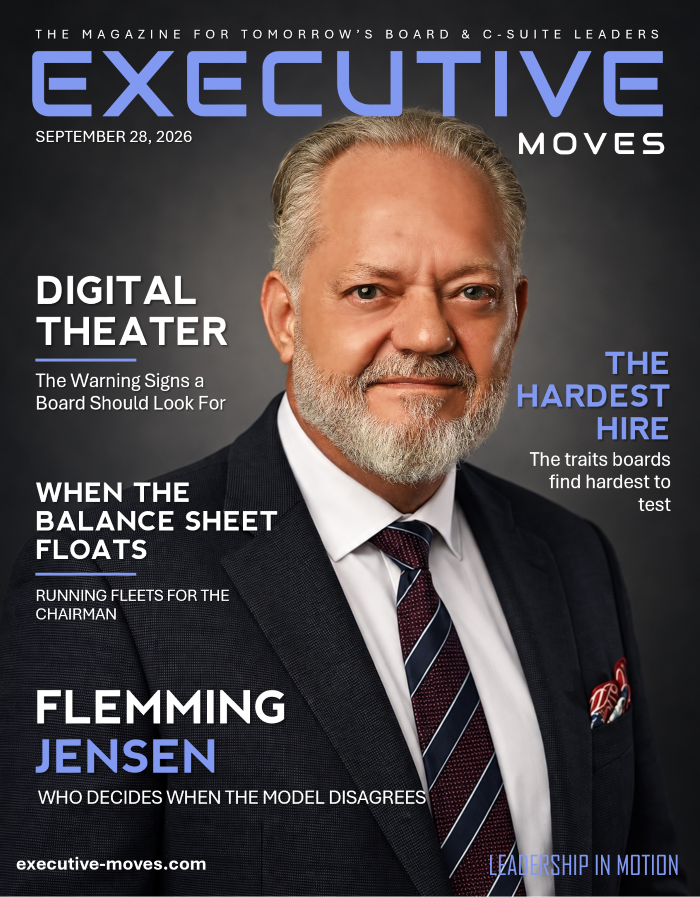
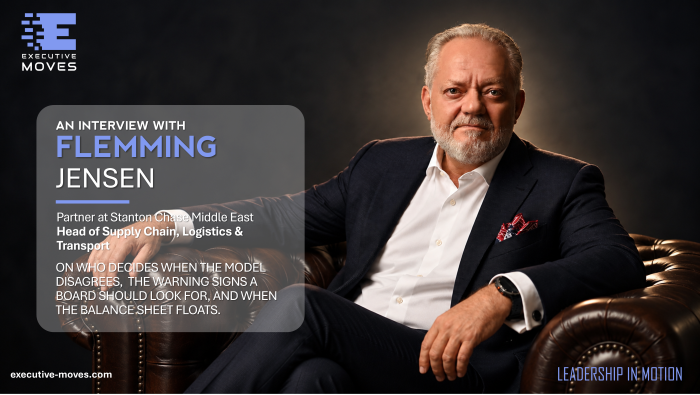
Flemming Jensen spent 36 years in shipping, logistics and offshore services, from Maersk trainee in Copenhagen to chief executive in the Gulf, before moving into executive search. Now a Stanton Chase Partner, he argues that operators buying the same AI will not get the same return, and that the difference lies in who is allowed to decide what.
Ask Flemming Jensen who decides when the forecasting model and the commercial director disagree, and he starts with the easy answer. "People decide, and experience and intuition count for a great deal," he says. Then he asks why they disagree at all. Perhaps the model lacks data. Perhaps a flawed process means the director's own numbers were doubtful from the start. "Either way the disagreement is telling him something about his own business," he told Executive Moves.
It is an operator's answer, and Jensen spent 36 years in shipping, logistics and offshore services before moving into executive search. He joined Maersk as a shipping trainee in Copenhagen in 1988 and was posted to Dubai as an assistant sales manager in 1990. He then served as Maersk Line's owner's representative in Saudi Arabia, and later in Bahrain and Qatar, where from 1993 to 1995 he was also Honorary Consul of Denmark in Bahrain. After three years in Copenhagen as Trade Manager for Maersk Line's Transatlantic Service, he returned to the Gulf in 1998 as Denmark's Consul and Trade Commissioner in the UAE, presiding over the Danish Business Council in Dubai.
Two decades of running businesses followed. He was General Manager of S.T.I. Middle East and Mohebi Logistics, then CEO of Arshiya International's Middle East region. From 2010 to 2016 he was Executive Vice President, Middle East, Indian Subcontinent and Africa at Inchcape Shipping Services, with 78 offices and a seat as Director or Chairman of every company in the region. He went on to lead DTA Maritime, founded FJ Advisory in 2021 to take on turnarounds, M&A and interim management, and returned to the chief executive's chair at Marine Capabilities (Marcap) in Abu Dhabi, a fleet of about 30 vessels. In May 2025 he joined Stanton Chase.
He is candid about getting a senior hire wrong. As a new CEO of a stagnating business, he hired a commercial chief whose success had come in a mature organisation, for a role that meant building capabilities first. The cost was mainly time, "and in a turnaround that is expensive," he says. His lesson: judge the fit with the job at hand, not only what a candidate has done before.
In a paper published this month, he argues that operators will largely buy the same technology, and that the difference will come from who changes how decisions are made. "Technology can be bought," he writes. "A leadership team that can use it cannot." The work, in his account, is defining what a system may decide alone, what a person must decide, and who answers for the outcome. "Clear rules matter as much for the AI colleagues as for the human ones," he says.
Who Decides
EM: Your recent paper argues that AI will transform logistics but leadership will decide who benefits. Unpack that for a board chair who still thinks AI is an IT budget line.
I see this often, and it is one of the main reasons I wrote the paper. Most boards now have AI on the agenda, and that is progress. But a chairman's job is to steer the company and keep it relevant, and treating AI as a budget line usually produces the opposite: systems bought, installed and delivering very little.
Buying the best available solution is not enough. What decides the outcome is what the board changes around it: how the organisation is structured, how work flows, what its leaders are capable of and, above all, who is allowed to decide what. If AI sits in the IT budget, it sits in IT's accountability too, and no operating executive owns the result.
I find it useful to think of AI as a set of colleagues working across functions, giving leaders accurate information when a decision is needed.
Done right, the company runs leaner, earns better returns, improves service and grows. Done wrong, the chairman watches margin and market share move to a competitor who treated AI as an enabler.
EM: When the forecasting model and the commercial director disagree, who decides? What does it look like when an operator actually writes its decision rules down?
The easy answer is that the commercial director decides, and it is the right one. People decide, and experience and intuition count for a great deal.
The more useful question is why they disagree at all. Does the model lack data it needs? Is a commercial or operational process flawed, so the numbers the director believes he can deliver are doubtful? Either way the disagreement is telling him something about his own business, and he should not sign off until he knows which. He may still back his own number, or he may have to change something to make it happen.
Writing the rules down makes them clear to everyone and gives the system boundaries to work inside. In practice that means defining what the system may decide alone, what has to be decided by a person, and who answers for the outcome. The operators who do this well also log the overrides, so a year later they can see who was right. Clear rules matter as much for the AI colleagues as for the human ones.
If AI sits in the IT budget, it sits in IT's accountability too, and no operating executive owns the result.
Flemming Jensen
The Apprenticeship
EM: You studied shipping at A.P. Moeller Shipping Academy and trained with Maersk before your first Gulf posting. What did that early training teach you about leadership that you still use today?
The training at A.P. Moeller combines academic knowledge with hands-on experience: time in different departments learning what makes the business move, and time on the front line, on vessels and with customers. Today that translates into a constant quest to learn, analyse and understand the business I am in, so that I can lead from knowledge of what works and what doesn't. In practice I would rather spend a day in the terminal or the warehouse than read a summary of it. The front line also teaches you quickly that some colleagues will always be stronger than you, and I always take their guidance into account before finalising a strategy or an important decision.
EM: For almost six years you were Denmark's Consul and Trade Commissioner in the UAE while presiding over the Danish Business Council. How did the diplomatic side shape the way you lead commercially?
Part of being a successful diplomat is engaging with people at every level of an organisation or a government, canvassing for the change that is needed, and persuading stakeholders to move in the desired direction. That skillset is powerful in a commercial setting, internally with your own people as much as externally with clients. My style now is to mentor, educate, persuade and build a strong solution before I go for the win, rather than to sell hard. Hard selling usually turns into a discussion about price rather than value.
The Operator Years
EM: At Inchcape you led 78 offices across three regions and sat as Director or Chairman of every company in them. How do you keep standards and culture consistent across that many markets?
Start by defining what those standards and that culture need to be, then plan how to bridge the gap from where the organisation is today. Much of that is talent management, linked to strategy, KPIs and performance management.
With 78 offices, you cannot be in all of them. I sat as Director or Chairman in all countries, but the more important role was head of the region, so you lead through your leadership teams and local management. Consistency depends on how strong those teams are.
What really makes it work is to lead from the front, in an engaging and consultative manner. Don't think you know everything, sitting in the ivory tower. You want colleagues who feel they are important stakeholders, rather than simple 9 to 5 employees.
EM: At DTA Maritime and Marcap you ran fleets of offshore and support vessels, reporting directly to the chairman. How is the CEO job different when your balance sheet floats, and when you answer straight to the chair?
As a CEO you are accountable, and the buck stops with you. The chairman has entrusted you with protecting his interests. When the balance sheet floats, your money is tied up in vessels that have to be crewed, maintained and kept working, and they cost you every day whether they are earning or not. Financial performance moves from month to month, and if you cannot explain why, you have a problem. It's not the CFO or the CCO the chairman will look to, it's you.
The answer is the right team around you and strong processes, so mismatches are found and corrected in the business rather than discovered in the board pack. Financial AI agents will alleviate the problem, but if the underlying processes are not fixed, the balance sheet will keep floating.
EM: Tell us about a senior hire you got wrong as a CEO. What did it cost, and what did it teach you?
A mistake CEOs often make is to think that a leader who has excelled in one setting will do the same in an entirely different one. I made that mistake.
When I took over a business that was stagnating and needed transformation and growth, I hired a CCO who had grown revenue lines beyond targets in a mature organisation, with strong, competitive solutions and quality service delivery already in place. In the new organisation the role included building those capabilities and solutions before taking them to market, and the CCO did not have it in him.
The cost was mainly time, and in a turnaround that is expensive. Growth stayed behind plan, we had to catch up later, and I had to run the search a second time while the business waited.
The key learning is to ensure a strong fit between the candidate and the job at hand, not just to look at what they have done before. Beyond capability, cultural fit and adaptability to new situations matter just as much.
Crossing the Table
EM: After decades running businesses you founded FJ Advisory, working on turnarounds, M&A and interim management, and then joined Stanton Chase. Why cross the table from hiring leaders to advising on them?
Having transformed and grown a number of businesses as a CEO, I was often called on when a strategy was weak, an asset was underperforming or an opportunity needed evaluating. I turned that into a business, so I could assist more than one owner or board.
The advisory work kept showing me that the strategy on paper was often not the real problem. What decided the outcome was whether the leadership team could deliver it.
So it did not feel like crossing the table. Advising owners and boards on their leadership is the same problem I had been solving earlier. What changed is the toolbox. At Stanton Chase it includes the Fit-for-Purpose Assessment Framework, which tests technical alignment, leadership capability and cultural fit rather than a track record alone.
EM: More than 15 years ago you sat on Arshiya's IT Strategy committee. From the CEO's chair, what did you learn about why technology programmes succeed or stall? Is AI different in kind, or only in speed?
The programmes that worked were the ones the business owned, where a line executive had it in his objectives and the processes were changed to match. The ones that stalled were owned by IT, while everybody quietly kept running the old process alongside the new system. You end up paying for both.
AI is different in kind. With the earlier programmes you were digitising the business, taking what you already did and putting it on a system. With AI you are enhancing the business itself, remodelling its processes and changing the way it is managed. That is why it cannot sit with IT, and why it has to take the executive team with it.
The Hard Part
EM: You describe "digital theater": the technology is installed but the organisation has barely moved. What are the warning signs a board should look for?
The first warning sign is in the reporting. If what is reported to the board is activity and the status of system implementation, rather than what changed in the numbers and processes, then very little has changed in the business.
The second is ownership. Ask which executive carries AI outcomes in their objectives this year. If the answer is the CIO or a transformation office, the operation has not taken it on.
EM: You say the hardest change is personal. How do you help a leader with 30 years of instinct on the quay accept a system that is sometimes right when they are wrong?
The logistics industry is full of leaders with decades of experience in traditional decision making, and it can be difficult for them to accept that there is now a better way of managing the business.
The answer is to show them, but in their own operation rather than in a demonstration. Keep the decision with them, let them overrule the system whenever they choose to, and record what happened afterwards. After a couple of quarters they have their own evidence, in their own numbers, and nobody has had to tell them they were wrong.
After a couple of quarters they have their own evidence, in their own numbers, and nobody has had to tell them they were wrong.
Flemming Jensen
The Gulf Lens
EM: Why does this land harder in the Gulf, particularly in owner led businesses where authority sits with a few people who built the company on judgement?
Many of the owners in the Gulf started and led businesses to amazing success decades ago, on entrepreneurial spirit, connections and hard work. Their expertise and judgement meant success. So how do you now persuade them that a business model that has been very successful is quickly becoming outdated?
More than likely, these owners will already have noticed competition growing stronger, and will have identified that this is often due to new smart solutions. AI is on the agenda in the boardroom, but not to change the way the business is run.
The Hiring Consequence
EM: You list five traits boards should add to the specification for the next generation of logistics leaders. Which is hardest to assess, and how do you test for it?
Willingness to give authority away. It is the hardest to assess because everybody says yes to it. A record of building strong teams does not settle it either, because delegating to a system is not the same as delegating to a person, who can be argued with and held to account in a way a model cannot.
So I do not ask the question directly. I ask what they have already given up: which decisions they stopped making in their last role, who took them over, and what went wrong afterwards, because something always does. Then I ask for an occasion when the data said they were wrong and they changed their mind. The ones who cannot give authority away rarely have an example.
The ones who cannot give authority away rarely have an example.
Flemming Jensen
Closing
EM: Describe the logistics CEO of 2030 in three words.
Transforms, defines, delegates.
Career at a glance
| Years | Organisation | Role |
|---|---|---|
| 1988 to 1990 | A.P. Moeller Shipping Academy | Bachelor in Shipping |
| 1988 to 1990 | Maersk Tanker and Maersk Line, Copenhagen | Shipping Trainee |
| 1990 to 1991 | Maersk Line, Dubai | Assistant Sales Manager |
| 1991 to 1993 | Maersk Line, Saudi Arabia | Owner's Representative |
| 1993 to 1995 | Maersk Line, Bahrain and Qatar | Owner's Representative; Honorary Consul of Denmark in Bahrain |
| 1995 to 1998 | Maersk Line, Copenhagen | Trade Manager, Transatlantic Service |
| 1998 to 2003 | Ministry of Foreign Affairs of Denmark | Consul and Trade Commissioner, UAE; President, Danish Business Council Dubai |
| 1998 to 2000 | University of Leicester | MBA |
| 2004 to 2007 | Mohebi Logistics (Zainal Mohebi Group) | General Manager, S.T.I. Middle East and Mohebi Logistics |
| 2007 to 2010 | Arshiya International | CEO, Middle East Region |
| 2010 to 2016 | Inchcape Shipping Services | Executive Vice President, Middle East, Indian Subcontinent and Africa |
| 2017 to 2021 | DTA Maritime | CEO |
| 2021 | FJ Advisory | Founder |
| 2023 to 2024 | Marine Capabilities (Marcap), Abu Dhabi | CEO |
| 2025 to present | Stanton Chase | Partner, Head of Supply Chain, Logistics and Transport practice, Middle East |
Five questions to take to your next board meeting
- Where is a machine already deciding for us? Identify where a system now makes a call that used to belong to management, and who signed that off.
- Have we written down who decides? Set out what the system may decide alone, what needs a person, and who answers for each, before the model and an executive next disagree.
- Where should we not trust the model? Ask whether the leadership team knows where a model is weak and how to interrogate a recommendation it dislikes.
- Do we trust our own data? Ask whether the business knows what its data is worth, or has bought a platform to sit on top of records it does not trust.
- Is this the team for the next three years? Ask whether the current leadership team is the one that will run the operation in three years, and if not, when the board starts building the next one.
Adapted from Flemming Jensen's paper "AI Will Transform Logistics. Leadership Will Decide Who Benefits." (Stanton Chase, September 2026).