


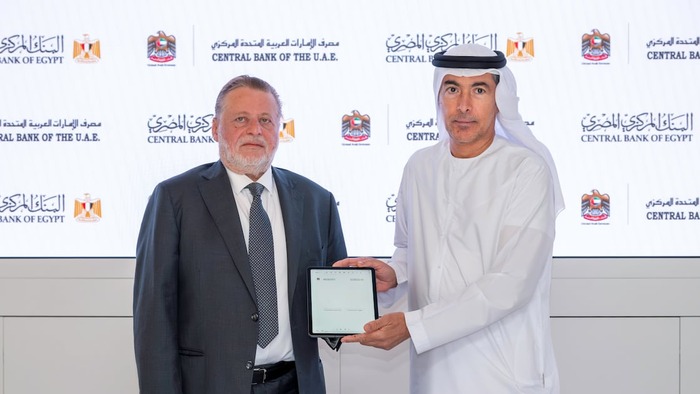
The Central Bank of the United Arab Emirates and the Central Bank of Egypt have renewed their bilateral currency swap agreement for a further five years, keeping the facility at 5 billion dirhams, equivalent to about 1.36 billion dollars, against 69 billion Egyptian pounds. The agreement was signed in Abu Dhabi by Khaled Balama, Governor of the Central Bank of the United Arab Emirates, and Hassan Abdalla, Governor of the Central Bank of Egypt, and renews an arrangement first struck in September 2023 at the same value.
Both institutions framed the renewal as a step towards greater use of local currencies in bilateral settlement. Balama said the agreement demonstrates a shared commitment that contributes to financial stability and facilitates trade and investment flows between the two countries.
The commercial backdrop explains the timing. Bilateral trade between the two countries reached 9.7 billion dollars in 2025, a 62 per cent increase year on year, split between 7 billion dollars of Egyptian exports and 2.7 billion dollars of imports from the United Arab Emirates. A swap line of this size does not finance that flow in full, and it is not designed to. What it does is give each central bank a standing claim on the other's currency at a pre-agreed rate, so that importers and exporters settling in dirhams or pounds are not forced through the dollar at every leg.
That matters more to Cairo than to Abu Dhabi. Egypt has spent three years rebuilding foreign currency reserves after the devaluations of 2022 and 2024, and every settlement that clears in local currency is a settlement that does not draw on hard currency reserves. The swap is therefore best read as a reserve management instrument on the Egyptian side and as a trade facilitation instrument on the Emirati side, which is why the headline value has not needed to change in three years even as trade between the two has grown by more than half.
The renewal also sits inside a much larger Emirati position in Egypt. The United Arab Emirates is among the largest foreign investors in the Egyptian economy, and its exposure runs through real estate, ports, telecoms and financial services. A functioning settlement channel in local currency reduces the friction on repatriating income from those holdings and lowers the currency risk attached to new commitments.
The practical test of the facility is utilisation rather than headline size. Swap lines of this kind are frequently signed, renewed and left largely undrawn, and neither central bank disclosed how much of the 2023 line was used over its term.